Showing posts with label photography. Show all posts
Sunday, April 7, 2013
Making Yourself at Home on Mars
One of the most interesting results of NASA's policy to make its planetary images widely and freely available is that talented photographers around the world have combined and extended the photos to make clearer or wider views of what it's like to be on another world.
A wonderful example can be found at a site for panoramic (360-degree) images, where photographer Andrew Bodrov has made one of the most exciting space images I have yet seen:
http://www.360cities.net/image/mars-gigapixel-panorama-curiosity-solar-days-136-149#-410.49,13.54,42.5
Bodrov stitched together 407 different images from two different cameras aboard the Curiosity rover on the red planet Mars. You can see the rover itself and the "Yellowknife Bay" neighborhood that it was exploring at the time that it did the first experiment drilling into a Mars rock. The large mountain in the distance is Mt. Sharp, the rover's ultimate destination.
I encourage you to play with the image for a while. There are controls at the upper left to help you move around and your cursor also gives you control of the speed and direction with which you move through this rich image. Enjoy the details of the rover's machinery and the wide range of rock formations around the little robot visitor.
Labels:
astronomy,
astronomy pictures,
astrophotography,
Curiosity,
Mars,
Mars rover,
NASA,
panoramas,
photography,
planetary probes,
planetary science,
planets,
science,
science news,
space,
space photography
Friday, March 29, 2013
A Gorgeous Galaxy Like our Own
We live in an enormous "island" of stars called the Milky Way galaxy -- a collection of over 200 billion stars (and probably billions of planets). Since we are inside the Milky Way, it's hard to take a complete picture of it. It's like trying to take a picture of yourself from inside your gall bladder -- the view is not too clear. But we can learn about our own galaxy by observing others that are like us in size and shape.
In this beautiful picture, assembled from a Hubble Space Telescope image, as well as color information from a Japanese telescope and other observers, you can see a near cousin of the Milky Way located at a distance of about 50 million lightyears. (That means the light from this great "city of stars" took 50 million years to reach us!)
This galaxy doesn't have a name (like most galaxies), but simply referred to by a catalog number -- NGC 7331. Like our Milky Way, it is a spiral-shaped assemblage of stars and cosmic gas and dust. It contains about the same amount of material as our galaxy. We see it tilted to our line of sight, accounting for its oval (rather than circular) appearance.
It appears from other observations that NGC 7331 has a giant black hole at the center that has swallowed much more material than the black hole at the heart of the Milky Way. We are no longer surprised when we find giant black holes at the cores of galaxies -- it appears most grown-up galaxies have them.
Above and to the left of NGC 7331 are two other galaxies, which are about 10 times farther away! They just happen to be in the frame of the picture, like movie extras behind the actor whom our attention is focused on. Billions upon billions of galaxies make up the observable universe.
This gorgeous picture was assembled from different sources by Dr. Robert Gendler, a physician on the East Coast, whose passion is astronomical photography and whose skill at computer rendering of our skies is extra-ordinary. As many students and teachers travel or rest for spring vacation around this time of year, here is a celestial tourist sight for your enjoyment.
Tuesday, September 25, 2012
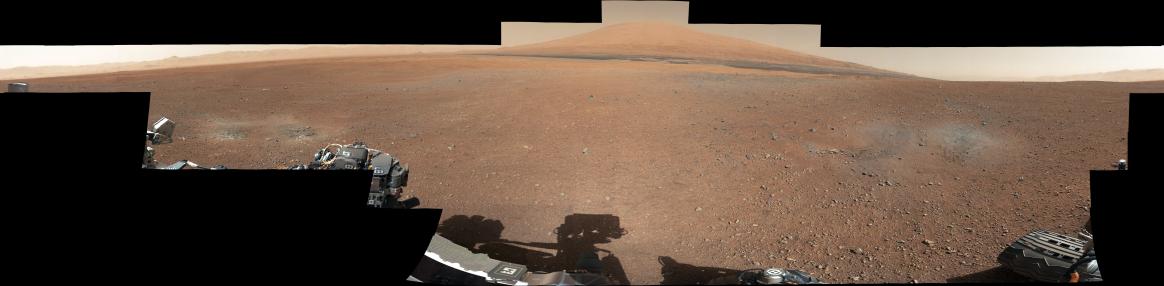
Remarkable New Mars Panorama
For your viewing pleasure, here is a dynamic 360-degree panorama of what you would see around you if you were with the Curiosity Rover on Mars, created from NASA images by Danish photographer Hans Nyberg. Note the tall mountain, Mt. Sharp, in the background. Note that the picture above is only a static appetizer. You have to click on the link below to get to the really wonderful, processed panorama that you can move through.
http://www.panoramas.dk/mars/curiosity-first-color-360.html
Once you are there click on the box with the four arrows inside the picture to have it go full screen on your computer. The colors have been changed a bit to show you what the scene would look like in Earth sunlight, but the level of detail is quite spectacular. Several people I have shown this to have commented that it really gives them the sense of what it might be like to stand on the surface of the red planet as a visitor.
Subscribe to:
Posts (Atom)

.jpg)