Showing posts with label robotic exploration. Show all posts

Sunday, September 30, 2012

Evidence for a Stream on Mars


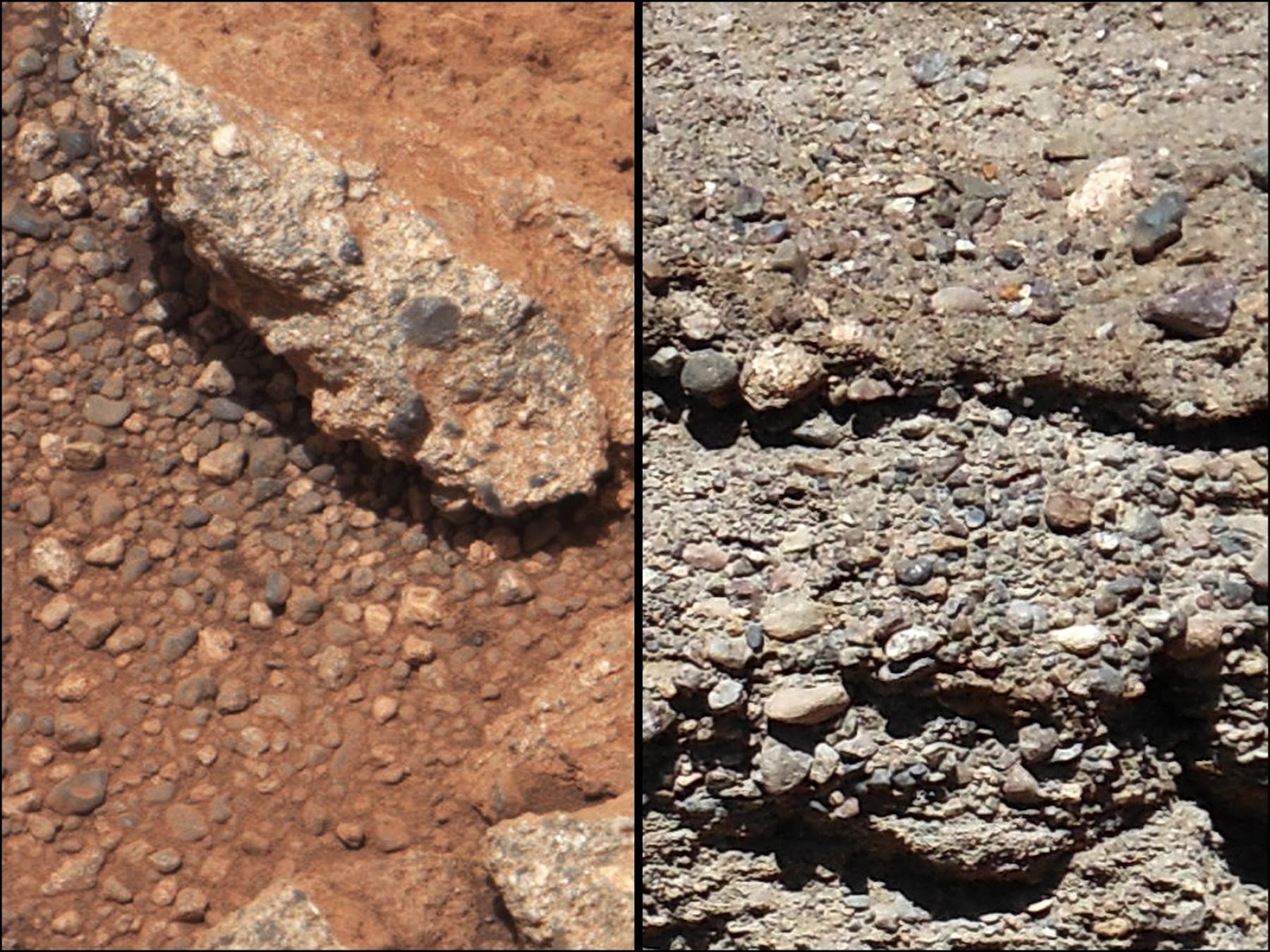
The first significant result from the Curiosity Rover in the deep Gale crater on Mars is the discovery of a set of rocks that look like they were shaped by a small river or stream of flowing water. 

Here is a picture with the Mars rocks on the left and rocks from an Earth stream bed on the right. Look how similar they are!

Scientists estimate that the stream of water on Mars that (long, long ago) produced these gravel formations was running at about 2 miles per hour. It was somewhere between ankle and hip deep.

That's great news. We landed in Gale Crater because pictures from orbit gave us hope that it had been full of water at one time. Now we have "ground-truth" for that idea. 

The gravel pieces on both pictures are too big to have been moved around by wind. It takes a fluid like water to knock these pieces together over the long time that water flowed. Within each rock, the largest gravel fragments are a couple of inches or so wide. (Scientists call this kind of rock a sedimentary conglomerate, and these are made by flowing water cementing rock fragments and smaller material together.) Both the kind of rock and the rounded shape of the fragments are strong arguments for a flowing stream of water on Mars. And our journey on Mars with Curiosity is just starting out!

For another image and the story from NASA, see: http://science.nasa.gov/science-news/science-at-nasa/2012/27sep_streambed/ 


Tuesday, September 25, 2012

Remarkable New Mars Panorama


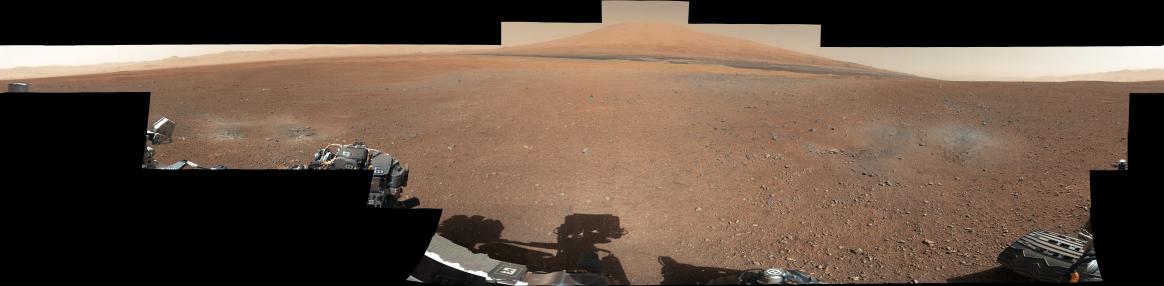
For your viewing pleasure, here is a dynamic 360-degree panorama of what you would see around you if you were with the Curiosity Rover on Mars, created from NASA images by Danish photographer Hans Nyberg. Note the tall mountain, Mt. Sharp, in the background.   Note that the picture above is only a static appetizer. You have to click on the link below to get to the really wonderful, processed panorama that you can move through.

http://www.panoramas.dk/mars/curiosity-first-color-360.html

Once you are there click on the box with the four arrows inside the picture to have it go full screen on your computer. The colors have been changed a bit to show you what the scene would look like in Earth sunlight, but the level of detail is quite spectacular.  Several people I have shown this to have commented that it really gives them the sense of what it might be like to stand on the surface of the red planet as a visitor.

Sunday, August 19, 2012

Mars Update


In this beautiful picture, you can see what the NASA publicity team is calling the "Promised Land" on Mars. The slope of Mount Sharp beckons in the distance in this color image taken by the Curiosity Rover's mast camera. The Mars light, by the way, has been adjusted on this image to show you what the scene would look like in Earth sunlight.   You can see that they have added a white bar on the mountain which is 2 km, or about 1.2 miles, wide.

The highest point on Mt. Sharp rises about 3 miles above its base. Note that in the picture, the lower parts of the mountain are darker than the rest. It is this dark region that we believe was covered with water long ago and is expected to show us the chemical and mineral traces of having been long submerged.

Also check out the image below for a bird's eye view (or more precisely, a spacecraft's eye view) of where Curiosity is now (green dot), where it is going first (Glenelg blue dot), and where it will approach Mt. Sharp (the blue dot in the center). Note that the elevation rises as you move toward the bottom right in this picture. 


Today, Curiosity fired its laser beam for the first time at a rock on Mars, with 30 pulses over 10 seconds. This vaporizes the rock, so that Curiosity can measure very precisely what it is made of. Scientists using the ChemCam instrument were delighted with the information coming into their little "mini-telescope" from the flash of the vaporized rock.  For more information, see: