Showing posts with label planets. Show all posts

Monday, December 31, 2018

Encounter with the Furthest Object Humanity Has Ever Explored


Tonight, the New Horizons spacecraft will fly by a chunk of ancient ice and dirt nicknamed "Ultima Thule." 4.1 billion miles distant from us, this small world, estimated at perhaps 20 miles across, is the the furthest object ever visited and examined by human technology. We should have first pictures and other information about it by Wednesday, when NASA plans a press conference.
The accompanying image shows an artist's attempt to draw this minor member of the zone beyond Neptune we call the Kuiper Belt. Pluto is also a member of this belt, but with far better property and voting rights than little Ultima. Several observations from afar have suggested that Ultima is elongated (maybe even two chunks that might just barely touch) and reddish. Its orbit indicates that it may well be very ancient, one of the first building blocks from which our solar system (the planets and moons that accompany the Sun) was assembled more than 4 1/2 billion years ago.
Moving at 32,000 miles per hour, and with sunlight only 1/2 of one percent as bright as it is at Earth, New Horizon's cameras will be put to the test to take pictures. The power (from radioactive materials) available to power the spacecraft is now only 190 watts! We will get within 2200 miles of the Ultima, closer than we got to Pluto with the same spacecraft in 2015.
New Horizons can either point at its target or at Earth. So it will at first send very little information and spend most of its time as it whizzes by pointing at Ultima. When it has gone by, it will point back to Earth and take 20 months to send the encounter data back to Earth (it's transmission rate is slow, but steady, much like this Facebook page.)
By the way, the term Ultima Thule means "Beyond the Known World"; it was term used on medieval maps to mark parts of our planet that were not yet explored and thus were veiled in mystery.  (It was a nickname suggested in a public naming contest run by the SETI Institute.)
Keep your fingers crossed that things go better 4 billion miles from Washington DC than they have gone at home! 

Tuesday, December 11, 2018

A New Selfie from Mars


NASA's InSight lander on Mars has sent back its first "selfie" -- a great mosaic of 11 images, taken by the color camera on the "elbow" of its robotic arm. You can clearly see the round solar panels (7 feet wide) which collect power for the lander, and, between them, the instrument deck for measuring weather, marsquakes, and other conditions on Mars. Eventually, the instrument package nicknamed the mole will try to dig a hole 16 feet deep and see how heat flows inside the red planet. It's terrific to see InSight's systems slowly being tried out and working so well.

Click on the picture to see it larger.

Wednesday, November 14, 2018

A Possible New Planet Around the Second Closest Star System to Earth


An international team of astronomers is announcing the possible discovery of a planet around the second closest star system to us, Barnard’s Star. A mere 6 light-years away, the star is a faint red dwarf which gives off only four hundredths of a percent of the Sun’s light energy. The planet, which could be as massive as 3 Earths, is orbiting at the same distance as Mercury is from the Sun, but is still colder than Saturn and unlikely to harbor life as we know it.
Since the closest star system to us also has a known planet in it, this discovery (if it is confirmed) would make it even more likely that planets are “more common than dirt” out there. Four planetary systems would then be known among the stars 10 light-years or closer. Some 2900 planetary systems (containing almost 4,000 planets) have now been found in our galactic neighborhood.
The new planet, which takes 233 days to orbit, was detected from the very slight “wiggles” that the planet’s gravity (as it goes around) gives to the motion of its star. The wiggles are so small that it took 20 years of observations, using special equipment on various telescopes around the world, to identify them. While it’s still possible that their combined observations have another explanation, the 63 authors on the paper announcing the planet have dug deeply into their data statistics and claim that the planet idea is the most likely explanation. Not all experts in the field agree that this is a definite detection. Instruments of the future, with better ability to detect tiny star wiggles, will ultimately decide if the planet is real.
Our image shows an artist conception of what the the “cold, hostile desert” surface of the planet around Barnard’s Star, with a temperature of -270 degrees Centigrade, might look like. (You will need to take your parka if you go.)

Wednesday, September 13, 2017

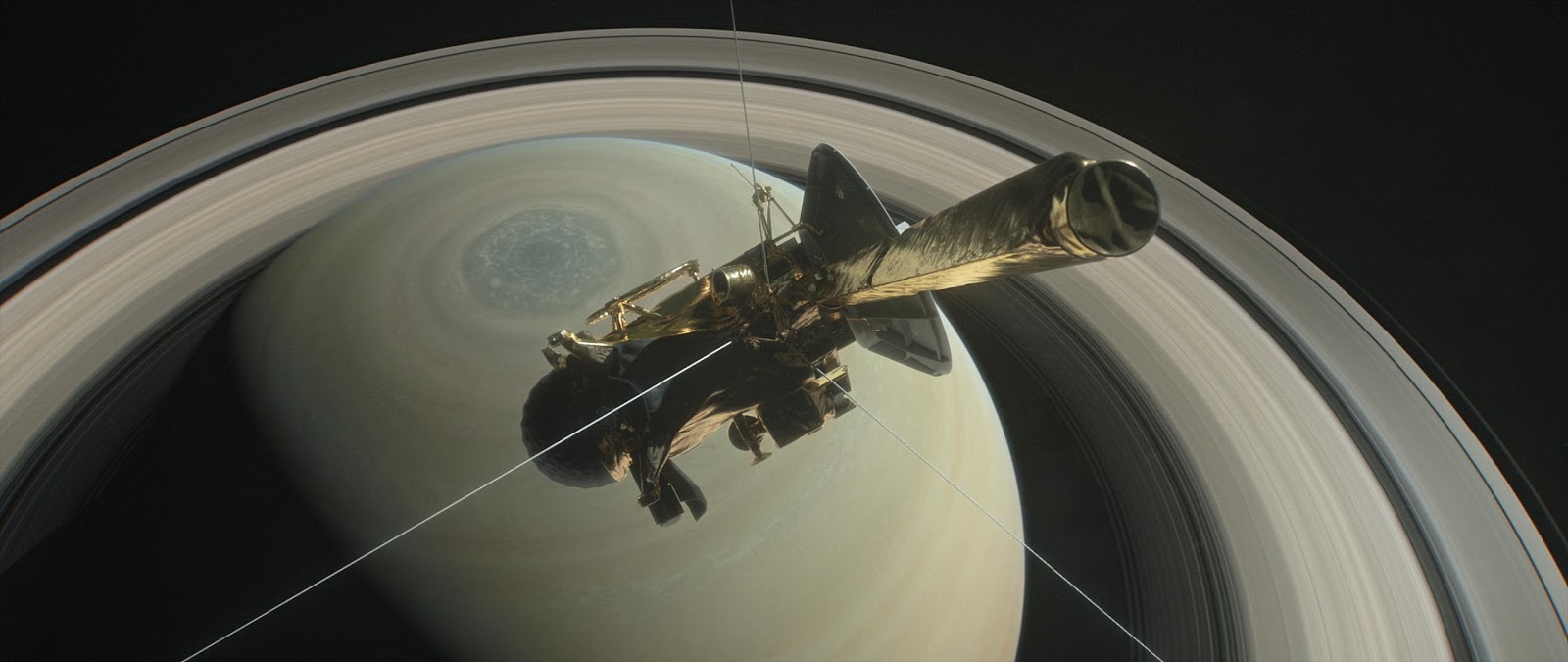
Cassini Space Probe To Fall Into Saturn Friday Morning


Friday morning, around 5 am Pacific time, NASA will send the Cassini space probe falling into the planet Saturn -- until it is crushed by the pressure in the ringed planet's atmosphere. NASA is commanding Cassini to "commit suicide" before its propellant runs out and it can't be steered any more. Since Saturn has two moons which might harbor some sort of primitive life, we wanted to make sure we did not contaminate those worlds.

The planet Saturn is made mostly of gas and liquid (and its make-up is dominated by the two lightest elements in the universe, hydrogen and helium.) So you can't land ON Saturn, you can only fall INTO Saturn (like a giant ocean world.)
Cassini has been orbiting Saturn for 13 years, sending back amazing pictures and information on the planet, its complicated rings, and its 62 moons. It's made a slew of remarkable discoveries, including the presence of warm salt-water geysers on the relatively small moon called Enceladus, and lakes and rivers of liquid fuel oil on the giant moon Titan. It was launched 20 years ago (so it's had a long and fulfilling life for a spacecraft.)
Since April, it has been swooping in and out of the space between Saturn's cloudtops and its inner rings, an area we had never had the nerve to explore before. NASA estimates the spacecraft has traveled almost 5 billion miles in total and has sent back more than 450,000 picture (that's a Flickr file not even your most picture-taking relatives can compete with!)
In our image, you can see Saturn and its complex ring system, with a painting of the spacecraft above the planet's north pole, ready to make a dive.
Some of my favorite pictures in the introductory astronomy textbook I am the lead author on come from Cassini (which was the most complicated planetary explorer ever built.) On Friday morning, let's give it a thought as we wake up -- we'll miss you, Cassini!
You can see live coverage of the last days of the mission on NASA TV at: http://nasa.gov/live
You can access the image galleries and latest videos from the mission from this page (designed for the media, but which anyone can use): https://saturn.jpl.nasa.gov/mission/grand-finale/for-media/
By the way, you can access my free textbook at : http://openstax.org/details/astronomy 

Wednesday, February 22, 2017

A Star With SEVEN Earth-like Planets


An international team of astronomers today announced that they have found a faint cool star that is surrounded by a system of seven planets, each of which resemble the Earth in size. Three of the planets orbits in what we call the "habitable zone" where water can be liquid and temperatures might be right for life.
The star, located about 40 light years away, is so faint and cool, it doesn't have a name like bright stars do. It's referred to by the name of the telescope that discovered it and given a number (TRAPPIST 1). Each of the planets is then given a letter from b to h. (See the diagram above.)
Note that the planets are all very close to their dim star, taking from 1.5 days to about 20 days to orbit it. (By comparison, the closest planet to the Sun, Mercury, takes 88 days to orbit.) Planets e, f, and g are the ones where the combination of a cool little star and close-by planet work out to make the temperatures potentially reasonable for life. This star enters the record books as the one with the largest number of Earth-like planets, and the largest number of candidate planets in the habitable zone.
Astronomers caution that the kind of star these planets live around (called an "ultra-cool red dwarf") tends to have a lot of "activity" on its surface when they are young. Great flares of energy and particles are given off in this kind of activity, which might flood the nearby planets with high-energy radiation. That might not be so healthy for the formation of life there until the star settles down to a more stable adult existence.
On the other hand, such low-mass stars (this one contains only 8% of the "stuff" our Sun has) tend to live much much longer than a star like the Sun, so there may eventually be a much longer opportunity for the planets to evolve their surfaces and atmospheres and give birth to life.
Another complication for planets so very close to their star is that their motion probably resembles that of our Moon in a crucial way. The Moon (and these planets) take the same time to orbit as to spin, which means they keep the same face toward the object they go around. So one side of each planet always faces their star and the other side is always in darkness. There is no day and night cycle on these worlds -- you either live on the star-facing side and have perpetual day or you live on the other side and have perpetual night. Only a significant atmosphere might make such a world more bearable and astronomers are using a variety of telescopes to probe whether these planets are surrounded by an air layer and how much and what kind of air they have.
Just to put the discovery in context, astronomers now know over 3,000 planets orbiting other stars, ranging from balls of gas and liquid much bigger than Jupiter, down to rocky balls smaller than Venus. Experts now estimate that perhaps half of the stars in our Milky Way Galaxy may possess planets, and many stars will have more than one planet, just like TRAPPIST 1 and the Sun do. The universe seems rich with planets of all kinds, making it more likely than ever that we are not the only form of semi-intelligent life in the cosmos.

Below is a little poster NASA created to show how the other planets in this system would look from the surface of one of them.


Wednesday, January 18, 2017

A New Photo of the Death-Star Moon

Just in time to anticipate the success of the Star Wars film "Rogue One", NASA released a new photo of Mimas, the moon of Saturn's that resembles the "Death Star."
Mimas, an icy world about 250 miles in diameter, has a giant crater on it which is 86 miles across. That's a single impact feature that is one third the diameter of the world that it’s on!!  Astronomers speculate that if the chunk that hit Mimas, exploded, and dug out that crater had been a little bit bigger it might well have shattered that moon.  Then Saturn might have had another ring system around it.
The crater has been named “Herschel” after the astronomer (and musician) who discovered Mimas.  In its center is a mountain that towers almost as high as Mount Everest on Earth.  It’s that central peak that helps our mind’s eye see Mimas’ resemblance to the evil superweapon in the Star Wars series.
The photo was taken in October by the Cassini mission, which has been exploring Saturn, its rings, and its moons since July 2004.  Its spectacular images find their way into every course I teach and every tourist tour of the solar system I guide in my public lectures.

Sunday, January 8, 2017

A Photo of the Earth and Moon from Mars!


   NASA has just released a remarkable image of the Earth and the Moon as seen from a spacecraft orbiting Mars. Our planet and Mars were 127 million miles apart when the photo was taken.
   The Mars Reconnaissance Orbiter (MRO) has been orbiting Mars since 2006, collecting very detailed close-up images and data about the surface of the red planet. In this case it was used to capture a photo of Earth and Moon with both bodies in the same frame. The image was taken at a time when the Moon was behind Earth as seen from Mars, so it shows the Earth-facing side of our natural satellite.
   Even at Mars' distance, the image of the Earth reveals continents. Australia is the reddish-brown feature in the center. Seeing ourselves as a tiny disk of light in the blackness of space can help remind us that we share a fragile and beautiful planet in our journey through space.

Sunday, October 23, 2016

Water Worlds in the Solar System


There is new evidence for the existence of liquid water in the cold outer regions of our solar system. Astronomers using the Hubble Telescope see plumes of water erupting from the surface of Jupiter’s moon Europa, and measurements of Saturn’s little moon Dione indicate that it must have a substantial layer of liquid water deep underground.
In recent years, more and more evidence has accumulated that liquid water exists among the moons of the giant planets. We have known for a while that there is likely to be an underground ocean of water beneath the icy crust of Jupiter’s moon Europa, and perhaps also under the surface of its moon Ganymede (the largest moon in the solar system.)
Then the Cassini mission found great geysers of salt water emerging from the icy cracks on Saturn’s moon Enceladus, a world much smaller than the Jupiter moons we just discussed. The big deal here is not that there is water, since water ice makes up a large part of many of the solid worlds in the outer solar system. The big discovery is that, even in those icy realms, enough heat can be generated inside these moons to have oceans of liquid water.

The Hubble work is the second report of plumes coming out of cracks in the ice of Europa. Earlier work, also done with the Hubble, also hinted at such plumes, but now astronomers have observed them in ultraviolet light as Europa was crossing the face of Jupiter. Our top image shows you what was observed, with a visible-light picture of Europa photoshopped in to show you what the moon looks like. A short NASA movie explaining the discovery can be seen at:
https://www.youtube.com/watch?v=4QJS9LcB66g
The work on Dione was more indirect. This moon of Saturn’s is about 700 mi across, more than twice as big as Enceladus. The presence of water was suggested by measurement of the gravity of Dione, as the Cassini spacecraft flew by it. The gravity measurements fit with the presence of a water layer deep inside the moon, perhaps 60 mi beneath the surface.
(The bottom image shows a very detailed image of Dione's surface from the Cassini spacecraft.  You see many icy cracks and fractures, whose sides show as white cliffs.)
Something must heat the buried “oceans” in these moons to keep them liquid. In some cases, it is a tug of war between the gravity of the mother planet on one side, and a large moon on the other. Or it may be some kind of rocking back and forth, which scientists call “libration”. Whatever allows liquid water layers to exist out there, the fact that they do makes them an interesting place to look for the beginnings of life.

Water Worlds in the Solar System


There is new evidence for the existence of liquid water in the cold outer regions of our solar system. Astronomers using the Hubble Telescope see a plume of water erupting from the surface of Jupiter’s moon Europa, and measurements of Saturn’s little moon Dione indicate that it must have a substantial layer of liquid water deep underground.
In recent years, more and more evidence has accumulated that liquid water exists among the moons of the giant planets. We have known for a while that there is likely to be an underground ocean of water beneath the icy crust of Jupiter’s moon Europa, and perhaps also under the surface of its moon Ganymede (the largest moon in the solar system.)

Then the Cassini mission found great geysers of salt water emerging from the icy cracks on Saturn’s moon Enceladus, a world much smaller than the Jupiter moons we just discussed. The big deal here is not that there is water, since water ice makes up a large part of many of the solid worlds in the outer solar system. The big discovery is that, even in those icy realms, enough heat can be generated inside these moons to have oceans of liquid water.
The Hubble work is the second report of plumes coming out of cracks in the ice of Europa. Earlier work, also done with the Hubble, also hinted at such plumes, but now astronomers have observed them in ultraviolet light as Europa was crossing the face of Jupiter. Our top image shows you what was observed, with a visible-light picture of Europa photoshopped in to show you what the moon looks like. A short NASA movie explaining the discovery can be seen at:
https://www.youtube.com/watch?v=4QJS9LcB66g
The work on Dione was more indirect. This moon of Saturn’s is about 700 mi across, more than twice as big as Enceladus. The presence of water was suggested by measurement of the gravity of Dione, as the Cassini spacecraft flew by it. The gravity measurements fit with the presence of a water layer deep inside the moon, perhaps 60 mi beneath the surface.
(The bottom image shows a very detailed image of Dione's surface from the Cassini spacecraft.  You see many icy cracks and fractures, whose sides show as white cliffs.)
Something must heat the buried “oceans” in these moons to keep them liquid. In some cases, it is a tug of war between the gravity of the mother planet on one side, and a large moon on the other. Or it may be some kind of rocking back and forth, which scientists call “libration”. Whatever allows liquid water layers to exist out there, the fact that they do makes them an interesting place to look for the beginnings of life.

Sunday, October 16, 2016

Ringshine on the Night Side of Saturn


A spectacular new image of the night side of Saturn and its shining rings in sunlight was released recently by the Cassini mission. You can also see the shadow Saturn casts on its rings.
This August 2016 view shows the complex structure of the planet's rings clearly. You can see the two gaps in the rings, one wider and one narrower (in the outer part of the outer ring.) Close-ups have revealed fainter rings and moons in the gaps, so they are not really as empty as they might seem.
The sunlight reflected from the rings keeps the night side of Saturn from being as dark as it could be, much as moonshine keeps the nights on Earth from being completely dark. One scientist calculated that if you could float in the upper cloud layers of Saturn (which has no solid surface), you could read an astronomy book by ringshine.
Look at the complexity of Saturn's rings -- ringlet after ringlet can be seen in each main ring. And each ringlet consists of millions of icy chunks, all orbiting together around the equator of Saturn. The main composition of these icy chunks is water -- making the rings a significant reservoir of water for future explorers. (Although two of Saturn's moons, Enceladus and Dione, are now thought to have liquid oceans of water under their icy crusts. Perhaps we can siphon some of that instead of melting ring chunks.)
The image was taken from a distance of 870,000 miles (which seems far, but Saturn was about 850 million miles from Earth at that time, so Cassini definitely had the better view.)

Thursday, September 22, 2016

A Great New Image of Saturn


NASA has recently released a spectacular new image of the planet Saturn, seen when it's summer in the Northern Hemisphere. (A year on Saturn is about 30 Earth years, so each season there lasts about 7.5 of our years! Saying goodbye for summer vacation is a big deal there.)
The rings are seen in fine detail with the shadow of the planet toward the left side. The mysterious hexagon-shaped storm at the north pole is also clearly visible. You are seeing Saturn from a distance of about 1.9 million miles.
The image was taken with the Cassini spacecraft that has orbited Saturn and shown us the planet, its rings, and its fantastic moons since 2004.
Enjoy. (Click on the image to see it bigger.)

Wednesday, June 15, 2016

Big Day for Astronomy Discoveries: Gravity Waves, Alcohol and Tatooine 9


The national organization of professional astronomers (the American Astronomical Society) is meeting in San Diego this week, and there is BIG news from the meeting: More gravity waves, wood alcohol in space, and a big Tatooine-like planet.
Scientists working with LIGO (the Laser Interferometer Gravitational-Wave Observatory) have announced their second discovery of gravity waves. (The first was announced in February.) Once again they observed two giant black holes coming closer and closer and then merging into a bigger black hole. In the merger, some of the mass in the system is converted to energy, and comes out as the waves of gravitational energy Einstein predicted about 100 years ago.
The black holes that merged were 14 and 8 times as massive as our Sun, somewhat smaller than those in the first discovery. Scientists estimate that the black hole that came out of the merger had as much stuff as 21 Sun. This means an entire Sun's worth of mass was converted to energy -- explaining why we could detect the gravity waves, even though such waves are much, much weaker than other waves we know and love, like radio or x-rays.
In the second discovery, a team of astronomers from around the world used the giant ALMA array of radio telescopes in Chile to measure the presence of alcohol in the planet forming disk of a young star 170 light years away. Alas, the kind of alcohol they found is what we call "wood alcohol" or methanol, not the drinkable version. Still, this is the first detection of one of the complex building blocks of life in the region around a newly formed star that is making planets as we observe it.
We have found many of the basic chemical building blocks of life in comets, in chunks of rock that fall from space, and especially in the great clouds of raw material (gas and dust) from which new stars form. But this is the first time we see the "fingerprints" of such a molecule in the flat disk around a star which is the nursery from which planets like Earth and Jupiter emerge. The name of the star is TW Hydrae in case you want to search for more information. (Our image shows an artist's impression of the disk and the molecules of methanol.)
And, finally, in a discovery that is bound to warm the hearts of Star Wars fans everywhere, astronomers have announced the discovery of the ninth, the largest, and the furthest planet orbiting two stars. Such a world could have two suns in the sky at the same time -- just like Tatooine, Luke Skywalker's home planet.
The newly discovered planet, called by its catalog number Kepler
1647b, is about the size of Jupiter and takes three years to orbit its star. The star system is about the same age as our own. And most intriguingly, the new planet orbits in the "habitable zone" of the double star -- meaning that the temperature in the planet's neighborhood would be comfortable for water and life as we know it.
Now Jupiter-sized planets are probably mostly gas and liquid, like Jupiter is, and have no surface for life to evolve on. But such planets may have large solid moons, like Jupiter and Saturn do. On such moons, an atmosphere and oceans may form and remain, so that an environment for life may yet exist in this strange, beautiful system. (We can't find moons yet, only planets, so for now, we have to leave such thoughts to the science fiction writers.)
And those three are only the most interesting of the many discoveries announced at the meeting. We really do seem to be living in a golden age of observational astronomy!

Saturday, May 21, 2016

Mars: Close and Easy to See (And Wet Long Ago)


Tonight, if you look southeast, you can see Mars as a bright red dot next to the full Moon. Mars is in one of its closer positions, about 48 million miles away. Mars is in what astronomers call "opposition" right now (which is not a term related to the Bernie and Hilary situation!)
When Mars is in opposition, it is on the opposite side of the Earth from the Sun. This means that when the Sun goes down, Mars comes up in our skies, and Mars will be up all night long. (Looking at our diagram from Sky & Telescope magazine, you should also be able to find Saturn this evening or tomorrow night, lower toward the horizon than Mars.)
In recent weeks, even more evidence has been accumulating that ancient Mars, billions of years ago, had a much thicker atmosphere and water was therefore liquid on its surface. Astronomers now believe that there were once lakes and even perhaps seas on the red planet. Recently, planetary scientists even found what seems like evidence of two episodes of tsunamis that happened on Mars a long time ago, when a big chunk of rock or ice from space hit a larger body of water.
For details of this investigation, see: http://www.psi.edu/news/marstsunami
(Also check out a great new Hubble image of Mars at:
http://www.spacetelescope.org/news/heic1609/ )

Wednesday, January 20, 2016

There is a Possible Super Earth in the Outer Solar System


Out there, way beyond the Sun's family, astronomers have discovered thousands of planets orbiting other stars. Among these alien planets, we have discovered a significant number of "Super Earths" -- planets more massive than our Earth but less massive than the smallest giants in our solar system, Uranus and Neptune. Our solar system has no such Super Earths, but many other systems do; they may be quite common.
Now, Michael Brown and Konstantin Batygin at Caltech, propose that we might just have a Super Earth in our solar system, but so far from the Sun, it takes between 10,000 and 20,000 years to make one orbit! (Pluto, for comparison, takes about 250 years.)
Brown and Batygin have been examining the orbits of icy chunks way beyond Pluto, in the region we call the Kuiper Belt. There are several chunks out there, including one Brown discovered in 2003, called Sedna, that move in an oddly aligned way. After testing many computer models to explain their odd orbit, their best model indicates there could be a planet 10 times the mass of our own Earth, whose stronger gravity is affecting the motions of many objects out where it orbits. Just a few of the affected chunks have been discovered so far and the planet itself has NOT be seen.
So this is a somewhat daring hypothesis, which the two astronomers explain in this brief video: https://www.youtube.com/watch?v=6poHQ2h00ZA
Please note that our image is a painting that Caltech commissioned. No one knows what this Planet Nine looks like.
Now here is the human side of the story. Michael Brown led the team that discovered Eris, the dwarf planet that is the same size as Pluto, in 2005. When he discovered it, he told his wife that he had just discovered a tenth planet and she had made a good decision in marrying him. Alas, instead of being acknowledged as the 10th planet, Eris caused astronomers to rethink the status of Pluto, and remove it from being the 9th planet. Brown was gracious about it, but you can imagine how disappointing it all was for him.
So now Brown may have "discovered" (or at least predicted) a real new planet. He is already nicknaming it "Planet Nine" and it's so big, no one will be able to call it a dwarf! If it is confirmed one day, he can go back to his wife and tell her, "Well, maybe I only discovered a dwarf planet before, but now I have discovered a real planet at last." Not a bad thing to discuss over dinner!
You can see a video where Brown discusses his role in the Pluto and Eris story at: https://www.youtube.com/watch?v=7pbj_llmiMg


Brown and Batygin

Thursday, December 31, 2015

Pluto Stamps to Debut in 2016


The U.S. Postal Service is going to release the set of two Pluto and New Horizons stamps in 2016 that you see pictured here. There has been an interesting connection between stamps and the Pluto mission.
In 1991, back when Pluto was still a planet, the U.S. issued a set of stamps showing close-up photos from space missions to all the planets except Pluto. The Pluto stamp was a drawing, and said "Not Yet Explored." This stamp so annoyed Alan Stern and and other astronomers who had been arguing for a Pluto mission, it gave them new energy to pressure NASA to approve a Pluto flight.
In 2006, just before New Horizons was launched, the scientists put one of those annoying stamps aboard the spacecraft and it was thus part of the mission that flew by Pluto last July. Having a U.S. stamp eventually leave the solar system amused the Postal Service people, and the new stamp of what Pluto actually looks like (with that nice heart shaped feature) is the happy result.
The Postal service is also planning to issue another set of stamps of the 8 planets (not including any pesky dwarfs this time) and a Star Trek commemorative series. See the full information at: https://www.nasa.gov/…/postal-service-honors-nasa-planetary…
Happy New Year to Fans of the Solar System and Stamp Collectors Everywhere! May your heart find fulfillment in the year ahead, just like Pluto's did..

Sunday, December 6, 2015

The Best Picture from Pluto So Far


The New Horizons spacecraft, which flew by Pluto in July, is slowly continuing to send back the images and data it took. The latest batch contains some of the most detailed close-up pictures of Pluto we have ever seen and they are fascinating!
Let’s take a look at the most intriguing new picture for a minute. We are seeing the greatest detail the spacecraft cameras were capable of. In a scene about 50 miles wide, we can make out details as small as half a city block. We see the shoreline of the Sputnik plains (part of the giant heart-shaped feature that caught everyone’s attention on the early pictures.)
The “rocks” that make up the mountains in the upper left are made of water – which is harder than rock at Pluto’s freezing temperatures. Some of these mountains are more than a mile and half high, with some of their sides bright with ice and others coated in a darker material that we are still learning about. This darker material may fall out of the sky, when ultraviolet light from the distant Sun causes chemical changes in Pluto’s thin atmosphere.
Notice how abruptly and cleanly the mountain end and give way to the softer, nitrogen-rich ice that makes up the Sputnik plains. In that ice, you can see huge but subtle cell-like structures. What makes up and drives this cell-like structure is still being debated by astronomers. Material in and around these cells may be moving up or down, like the cells you see when you boil miso soup. (If you've never boiled miso soup, ask a Japanese friend to tell you about it.) Cold nitrogen and methane ice might behave similarly when it is heated by the slightly warmer insides of Pluto and the faint heat of the Sun.
In an earlier photo, you can see some dark hills poking up at the boundary between cells, so this is very complicated terrain we are looking at. See the picture below. 
But just enjoy looking at the alien vista New Horizon’s cameras revealed. Pluto is not simple or boring!


Sunday, November 29, 2015

SETI Institute Searches for Giant Alien Construction Sites (and Your Support)


The team searching for signals from intelligent civilizations among the stars at the SETI Institute recently turned its radio telescopes to a mysterious star whose light output varies in an unusual way.   Called by its catalog number KIC 8462852, the star is about 1500 lightyears away in the constellation of Cygnus the Swan. Observations with the Kepler space telescope had shown that the star’s brightness dipped at irregular intervals and with irregular amounts of darkening.

Such dips are how the Kepler telescope finds planets orbiting distant stars.  Astronomers photograph huge numbers of stars regularly, and search for regular dips in a star’s light when a planet gets in front of the star, reducing its brightness.  A planet circles its star regularly, and the dips in brightness come on a clockwork schedule.  If the planet takes 100 days to orbit its star, astronomers would see a dip in brightness every 100 days – just while the planet is in front of its star.  Here is a little animation to show you the idea: https://www.youtube.com/watch?v=pf9PjFQIpzU

But KIC 8462852’s dips in brightness are not regular at all and they vary in how much of the star’s light they block.  One such dip in brightness took away more than 20% of the star’s light, indicating that whatever was causing it must be much bigger than a planet.  What could be causing such unpredictable and large dips?  It could, for example, be a huge swarm of comets that orbit the star in different clumps.  It could be great clouds of dust from deep space which the star happens to be moving through.  But there is another possibility, which got some astronomers and all science fiction fans excited.

What if there is an advanced civilization around that star, far beyond our own in technology?  One thing such a civilization is likely to need is huge amounts of energy to carry out their projects.   An easy way to get that is to build huge “solar panels” orbiting their star.  Alternatively, perhaps they are building giant space habitats to house their excess population. 

Just like our cities are irregularly spaced and irregular in terms of internal construction, so these space construction projects could be different in size and spacing, causing the irregular dips we see as they move in front of their star.  While the explanation is most likely something natural in the universe, it’s fun to consider a cause that could be a signal for the existence of intelligent life.

The leading organization in the search for life beyond Earth is the SETI Institute (where I have the privilege of serving on the Board of Trustees.)   They have an instrument, called the Allen Telescope Array (ATA), with 42 coordinated radio telescopes in Northern California, specifically designed to find intelligent radio or microwave signals from the stars.

For more than two weeks, the Institute team, led by Dr. Seth Shostak, trained the ATA on KIC 8462852, to see if any pattern of signals might be leaking from such an advanced civilization.  At a distance of 1500 lightyears (where each lightyear is 6,000 billion miles), the alien transmissions would have to be awfully strong to be detectable from Earth.  Still, a civilization able to build huge space structures might have powerful beacons to communicate with its own outposts, and we might be able to eavesdrop on one of their messages pointed our way.

So far, in the channels the Institute team searched, no intelligent signal was detectable.  They also searched for a much broader beam of microwaves, which advanced aliens might use to push giant ships through space.  No such beam was found either.

But what exciting ideas such observations bring to our minds!  The possibility of detecting some kind of intelligent species that is out there in the Galaxy has intrigued humanity for centuries.  Today, for the first time, we actually have the technology to do experiments in this area.  I’d love to see us find evidence that we have “cousins” among the stars.  This is why I have served on the SETI Board for many years now.

The Institute also does other wonderful research, in many areas of astronomy and planetary science.  (One of our scientists, Mark Showalter, found two of the small moons of Pluto, for example.)  There is also great work going on in education and public outreach, including the syndicated “Big Picture Science” radio show that Seth Shostak co-hosts.

December 1 is “Giving Tuesday” – a day designed for all of us to pause after the shopping frenzy that follows Thanksgiving, and consider giving to non-profit organizations whose work we believe in.  Perhaps you’d like to join me in supporting the SETI Institute.  For ways you can help, see their website at: http://www.seti.org/supportus


(NOTE: The photo shows a few of the radio telescopes that make up the Allen Telescope Array.)
And KIC stands for Kepler Input Catalog.

Sunday, November 22, 2015

Hot Discovery: Venus-like Planet around Red Dwarf Star


A newly discovered planet is as hot as your oven at full strength and takes less than two days to orbit its star.

As the number of confirmed planets orbiting other stars nears 2000 (when just twenty years ago, that number was zero), we are finding many planets that are not like any we know in our own solar system. The new planet orbits a red dwarf, a star 200 times fainter than our Sun, called GJ1132. (GJ stands for Gliese-Jahreiss, the name of two German astronomers who produced a remarkable catalog of the stars closest to our Sun.)

Astronomers used telescopes around the world to pin down the characteristics of the new planet, which is just 39 light years away, very close by cosmic standards. It turns out to be a rocky planet, a little bigger and more massive than Earth.

But it is so close to its star it takes only 1.6 days to go around. (In other words, a year on that planet would be just 1.6 Earth days. That means an Earth 10-year old would be about 2280 years old on that planet!)

At so close a distance (only a million and a half miles away from its star), the planet experiences temperatures on the order of 450 degrees Fahrenheit. So it reminds us more of superhot Venus in our solar system than our own Earth. Interestingly, other planets known to be rocky that we have discovered orbiting other stars are even hotter. (Hot, close planets are easier to find, so they are over-represented among our early discoveries.)

Still, if for some reason, you need a turkey cooked really fast this week, perhaps a quick trip to GJ 1132b (as the planet is boringly designated) would be in order. Or just give thanks that you live in a cooler planet which takes its time orbiting the Sun.

[P.S. The image is just an artist's impression. We can't photograph such small close in planets -- they are lost in the glare of their star.]

Monday, November 9, 2015

Pluto Has a Crazy Tumbling Moon (Great Video)


Pluto has five moons around it and one of them, it was reported today, spins 89 times for each orbit it makes around Pluto. Hydra, the outermost of Pluto's four tiny moons, takes 38 Earth days to go once around the dwarf planet. During that time, it rotates 89 times.

For a hypnotic video of the motion of all the moons, see:http://www.seti.org/…/defau…/files/dps-slides-showalter1.mp4

(Note that on the video, the moons are not to scale. In real life, the outer 4 moons are much much smaller than Pluto and the giant inner moon Charon, which is about half of Pluto's size. But the motion you see on the video is real.)

Hydra is the purple object on the video. The moon colored yellow, called Nix, spins almost fourteen times during one of its orbits. (The colors mean nothing on the video; they just help our eyes tell the moons apart.)

Astronomer Mark Showalter of the SETI Institute, who discovered two of the moons, is part of a team that suspects that the tumbling of the moons is caused by the extra pull that the giant moon Charon adds to the pull of Pluto in this system.

Another interesting fact about the motions in the Pluto system is that Pluto's day is equal to Charon's month.  In other words, Pluto rotates at the same rate as its giant moon orbits it.  That means Pluto and Charon are synchronized -- one side of Pluto always has Charon above it as it turns, and the other side of Pluto never sees Charon.  

By the way, it also appears from the New Horizons data coming back to Earth that Hydra and Kerberos (the green colored moon) are each made of two smaller chunks of ice that "merged" into one close system early in Pluto's history. Perhaps all four of the small moons are the result of such mergers. So here are two chunks of cosmic material living together intimately for billions of years. Perhaps the Tea Party fundamentalists and Supreme Court Justice Scalia might not approve of such a "marriage" between icy chunks, but I think it's pretty cool.

Sunday, October 11, 2015

Blue Skies on Pluto


The New Horizons team just released a great new image of Pluto in front of the Sun. If Pluto had no atmosphere, it would just have blocked the Sun's light for the camera. But Pluto's thin (but significant) atmosphere scatters blue light more than red, just like Earth's air does, and so we can glimpse blue skies (or at least blue haze) around Pluto in the picture.

The haze layers in Pluto's atmosphere (seen more clearly in the black and white photo below) are made of slightly larger particles than Earth's haze layers, a kind of alien soot.

The lower image, showing Pluto at sunset, shows how the haze has several layers in it. The atmosphere is a thin mixture of nitrogen, carbon monoxide, and methane. Not a place where you want to (or can) take a deep breath! Astronomers think the atmosphere of Pluto is a bit thicker when it's closer to the Sun in its 250-year orbit, and then freezes out when it moves away from the distant sun for most of its plutonian year.

Also on the lower image, you can see the contrast between the mountainous higher lands on Pluto, and then in the middle of the picture, the smoother frozen plains that interrupt them. Only about 10% of the images and data have been sent back by New Horizons so far, so we have much more to learn about the little planet we visited briefly in July.

(As always, click on the photos, to see more detailed versions. Feel free to pass the pictures and information on, if you like them.)