Showing posts with label Saturn. Show all posts

Wednesday, September 13, 2017

Cassini Space Probe To Fall Into Saturn Friday Morning


Friday morning, around 5 am Pacific time, NASA will send the Cassini space probe falling into the planet Saturn -- until it is crushed by the pressure in the ringed planet's atmosphere. NASA is commanding Cassini to "commit suicide" before its propellant runs out and it can't be steered any more. Since Saturn has two moons which might harbor some sort of primitive life, we wanted to make sure we did not contaminate those worlds.

The planet Saturn is made mostly of gas and liquid (and its make-up is dominated by the two lightest elements in the universe, hydrogen and helium.) So you can't land ON Saturn, you can only fall INTO Saturn (like a giant ocean world.)
Cassini has been orbiting Saturn for 13 years, sending back amazing pictures and information on the planet, its complicated rings, and its 62 moons. It's made a slew of remarkable discoveries, including the presence of warm salt-water geysers on the relatively small moon called Enceladus, and lakes and rivers of liquid fuel oil on the giant moon Titan. It was launched 20 years ago (so it's had a long and fulfilling life for a spacecraft.)
Since April, it has been swooping in and out of the space between Saturn's cloudtops and its inner rings, an area we had never had the nerve to explore before. NASA estimates the spacecraft has traveled almost 5 billion miles in total and has sent back more than 450,000 picture (that's a Flickr file not even your most picture-taking relatives can compete with!)
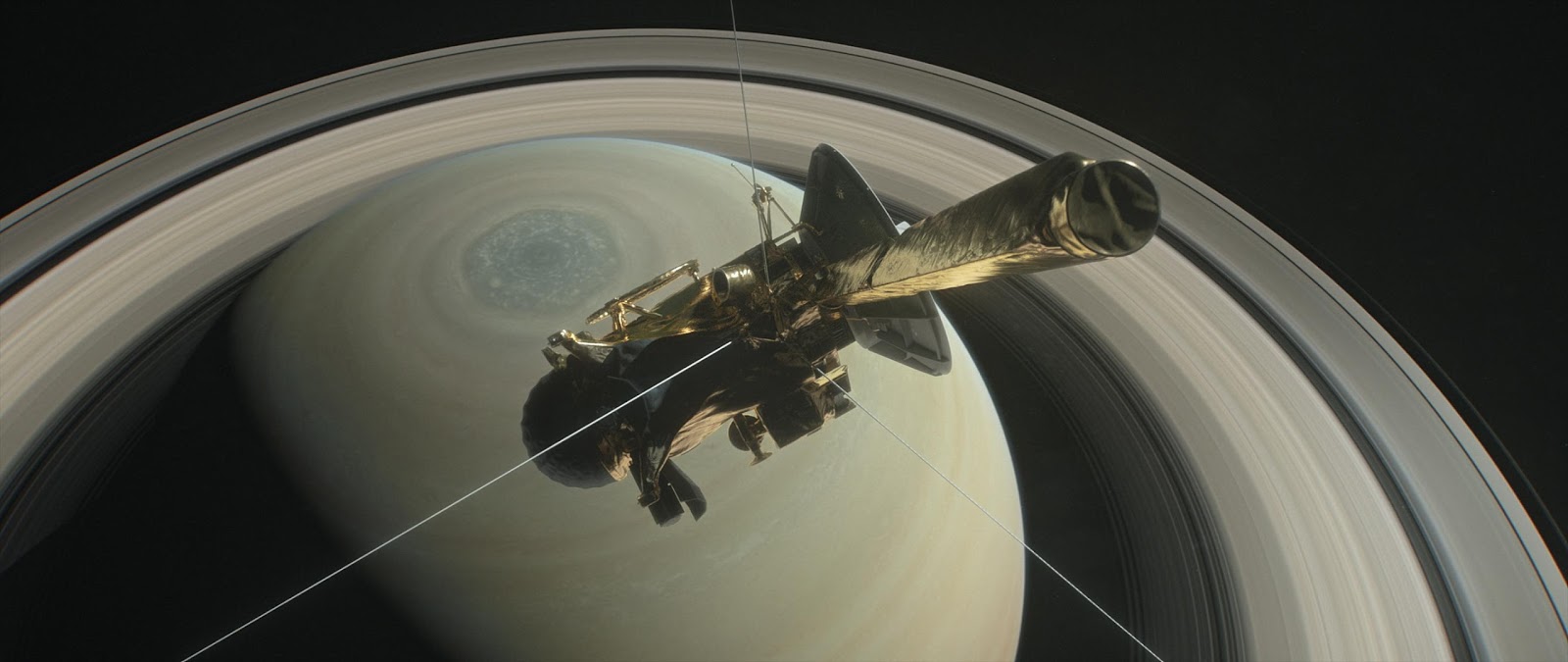
In our image, you can see Saturn and its complex ring system, with a painting of the spacecraft above the planet's north pole, ready to make a dive.
Some of my favorite pictures in the introductory astronomy textbook I am the lead author on come from Cassini (which was the most complicated planetary explorer ever built.) On Friday morning, let's give it a thought as we wake up -- we'll miss you, Cassini!
You can see live coverage of the last days of the mission on NASA TV at: http://nasa.gov/live
You can access the image galleries and latest videos from the mission from this page (designed for the media, but which anyone can use): https://saturn.jpl.nasa.gov/mission/grand-finale/for-media/
By the way, you can access my free textbook at : http://openstax.org/details/astronomy 

Sunday, May 14, 2017

A Weird-looking Moon in a Gap in Saturn's Rings


Since 2004, the sophisticated Cassini spacecraft has been orbiting Saturn, sending back remarkable pictures of the planet, its rings, and its moons.   Now, with its fuel running out, the little spacecraft is being directed closer to Saturn’s rings, to get us even better views of this spectacular region (before Cassini does a Kamikaze dive into Saturn Sept. 15th.)

The image above is a fantastic close-up of one of the strangest moons we have ever seen.  The small moon Pan orbits inside the Encke Gap, an emptier region in Saturn’s bright A ring (Saturn’s different rings are given letter names.)  Pan looks like a “flying saucer” – with a set of high ridges around its equator.  It's about 22 miles across at its widest point.

Astronomers think that Pan formed inside Saturn’s ring and, as it grew, its gravity helped clear out the material in the gap which it now rules.  But there was enough material still in the flat ring neighborhood that it fell onto Pan’s equator and made the giant ridges that make Pan so distinctive.

Over the next few months, as scientist program Cassini to dive again and again into the space between Saturn’s and its rings, we will continue to get better images of “things in the rings” (sounds like Dr. Seuss) than we ever have before.  It’s a fitting finale for a spectacular space mission.

The image below shows you the neighborhood.  You can see Pan, its shadow, the Encke gap, and the A ring.  

Wednesday, January 18, 2017

A New Photo of the Death-Star Moon

Just in time to anticipate the success of the Star Wars film "Rogue One", NASA released a new photo of Mimas, the moon of Saturn's that resembles the "Death Star."
Mimas, an icy world about 250 miles in diameter, has a giant crater on it which is 86 miles across. That's a single impact feature that is one third the diameter of the world that it’s on!!  Astronomers speculate that if the chunk that hit Mimas, exploded, and dug out that crater had been a little bit bigger it might well have shattered that moon.  Then Saturn might have had another ring system around it.
The crater has been named “Herschel” after the astronomer (and musician) who discovered Mimas.  In its center is a mountain that towers almost as high as Mount Everest on Earth.  It’s that central peak that helps our mind’s eye see Mimas’ resemblance to the evil superweapon in the Star Wars series.
The photo was taken in October by the Cassini mission, which has been exploring Saturn, its rings, and its moons since July 2004.  Its spectacular images find their way into every course I teach and every tourist tour of the solar system I guide in my public lectures.

Sunday, October 23, 2016

Water Worlds in the Solar System


There is new evidence for the existence of liquid water in the cold outer regions of our solar system. Astronomers using the Hubble Telescope see plumes of water erupting from the surface of Jupiter’s moon Europa, and measurements of Saturn’s little moon Dione indicate that it must have a substantial layer of liquid water deep underground.
In recent years, more and more evidence has accumulated that liquid water exists among the moons of the giant planets. We have known for a while that there is likely to be an underground ocean of water beneath the icy crust of Jupiter’s moon Europa, and perhaps also under the surface of its moon Ganymede (the largest moon in the solar system.)
Then the Cassini mission found great geysers of salt water emerging from the icy cracks on Saturn’s moon Enceladus, a world much smaller than the Jupiter moons we just discussed. The big deal here is not that there is water, since water ice makes up a large part of many of the solid worlds in the outer solar system. The big discovery is that, even in those icy realms, enough heat can be generated inside these moons to have oceans of liquid water.

The Hubble work is the second report of plumes coming out of cracks in the ice of Europa. Earlier work, also done with the Hubble, also hinted at such plumes, but now astronomers have observed them in ultraviolet light as Europa was crossing the face of Jupiter. Our top image shows you what was observed, with a visible-light picture of Europa photoshopped in to show you what the moon looks like. A short NASA movie explaining the discovery can be seen at:
https://www.youtube.com/watch?v=4QJS9LcB66g
The work on Dione was more indirect. This moon of Saturn’s is about 700 mi across, more than twice as big as Enceladus. The presence of water was suggested by measurement of the gravity of Dione, as the Cassini spacecraft flew by it. The gravity measurements fit with the presence of a water layer deep inside the moon, perhaps 60 mi beneath the surface.
(The bottom image shows a very detailed image of Dione's surface from the Cassini spacecraft.  You see many icy cracks and fractures, whose sides show as white cliffs.)
Something must heat the buried “oceans” in these moons to keep them liquid. In some cases, it is a tug of war between the gravity of the mother planet on one side, and a large moon on the other. Or it may be some kind of rocking back and forth, which scientists call “libration”. Whatever allows liquid water layers to exist out there, the fact that they do makes them an interesting place to look for the beginnings of life.

Water Worlds in the Solar System


There is new evidence for the existence of liquid water in the cold outer regions of our solar system. Astronomers using the Hubble Telescope see a plume of water erupting from the surface of Jupiter’s moon Europa, and measurements of Saturn’s little moon Dione indicate that it must have a substantial layer of liquid water deep underground.
In recent years, more and more evidence has accumulated that liquid water exists among the moons of the giant planets. We have known for a while that there is likely to be an underground ocean of water beneath the icy crust of Jupiter’s moon Europa, and perhaps also under the surface of its moon Ganymede (the largest moon in the solar system.)

Then the Cassini mission found great geysers of salt water emerging from the icy cracks on Saturn’s moon Enceladus, a world much smaller than the Jupiter moons we just discussed. The big deal here is not that there is water, since water ice makes up a large part of many of the solid worlds in the outer solar system. The big discovery is that, even in those icy realms, enough heat can be generated inside these moons to have oceans of liquid water.
The Hubble work is the second report of plumes coming out of cracks in the ice of Europa. Earlier work, also done with the Hubble, also hinted at such plumes, but now astronomers have observed them in ultraviolet light as Europa was crossing the face of Jupiter. Our top image shows you what was observed, with a visible-light picture of Europa photoshopped in to show you what the moon looks like. A short NASA movie explaining the discovery can be seen at:
https://www.youtube.com/watch?v=4QJS9LcB66g
The work on Dione was more indirect. This moon of Saturn’s is about 700 mi across, more than twice as big as Enceladus. The presence of water was suggested by measurement of the gravity of Dione, as the Cassini spacecraft flew by it. The gravity measurements fit with the presence of a water layer deep inside the moon, perhaps 60 mi beneath the surface.
(The bottom image shows a very detailed image of Dione's surface from the Cassini spacecraft.  You see many icy cracks and fractures, whose sides show as white cliffs.)
Something must heat the buried “oceans” in these moons to keep them liquid. In some cases, it is a tug of war between the gravity of the mother planet on one side, and a large moon on the other. Or it may be some kind of rocking back and forth, which scientists call “libration”. Whatever allows liquid water layers to exist out there, the fact that they do makes them an interesting place to look for the beginnings of life.

Sunday, October 16, 2016

Ringshine on the Night Side of Saturn


A spectacular new image of the night side of Saturn and its shining rings in sunlight was released recently by the Cassini mission. You can also see the shadow Saturn casts on its rings.
This August 2016 view shows the complex structure of the planet's rings clearly. You can see the two gaps in the rings, one wider and one narrower (in the outer part of the outer ring.) Close-ups have revealed fainter rings and moons in the gaps, so they are not really as empty as they might seem.
The sunlight reflected from the rings keeps the night side of Saturn from being as dark as it could be, much as moonshine keeps the nights on Earth from being completely dark. One scientist calculated that if you could float in the upper cloud layers of Saturn (which has no solid surface), you could read an astronomy book by ringshine.
Look at the complexity of Saturn's rings -- ringlet after ringlet can be seen in each main ring. And each ringlet consists of millions of icy chunks, all orbiting together around the equator of Saturn. The main composition of these icy chunks is water -- making the rings a significant reservoir of water for future explorers. (Although two of Saturn's moons, Enceladus and Dione, are now thought to have liquid oceans of water under their icy crusts. Perhaps we can siphon some of that instead of melting ring chunks.)
The image was taken from a distance of 870,000 miles (which seems far, but Saturn was about 850 million miles from Earth at that time, so Cassini definitely had the better view.)

Thursday, September 22, 2016

A Great New Image of Saturn


NASA has recently released a spectacular new image of the planet Saturn, seen when it's summer in the Northern Hemisphere. (A year on Saturn is about 30 Earth years, so each season there lasts about 7.5 of our years! Saying goodbye for summer vacation is a big deal there.)
The rings are seen in fine detail with the shadow of the planet toward the left side. The mysterious hexagon-shaped storm at the north pole is also clearly visible. You are seeing Saturn from a distance of about 1.9 million miles.
The image was taken with the Cassini spacecraft that has orbited Saturn and shown us the planet, its rings, and its fantastic moons since 2004.
Enjoy. (Click on the image to see it bigger.)

Saturday, May 21, 2016

Mars: Close and Easy to See (And Wet Long Ago)


Tonight, if you look southeast, you can see Mars as a bright red dot next to the full Moon. Mars is in one of its closer positions, about 48 million miles away. Mars is in what astronomers call "opposition" right now (which is not a term related to the Bernie and Hilary situation!)
When Mars is in opposition, it is on the opposite side of the Earth from the Sun. This means that when the Sun goes down, Mars comes up in our skies, and Mars will be up all night long. (Looking at our diagram from Sky & Telescope magazine, you should also be able to find Saturn this evening or tomorrow night, lower toward the horizon than Mars.)
In recent weeks, even more evidence has been accumulating that ancient Mars, billions of years ago, had a much thicker atmosphere and water was therefore liquid on its surface. Astronomers now believe that there were once lakes and even perhaps seas on the red planet. Recently, planetary scientists even found what seems like evidence of two episodes of tsunamis that happened on Mars a long time ago, when a big chunk of rock or ice from space hit a larger body of water.
For details of this investigation, see: http://www.psi.edu/news/marstsunami
(Also check out a great new Hubble image of Mars at:
http://www.spacetelescope.org/news/heic1609/ )

Sunday, October 4, 2015

"The Martian" and Other News of the Solar System


If you've seen, read, or heard about "The Martian" film or novel, you may know that it's a story by an engineer about survival on Mars. If you'd like some background on how author Andy Weir tried to make the story realistic, using known science, check out his talk at NASA's Ames Research Center at: https://www.youtube.com/watch?v=KBtXuBuZPpQ

The image accompanying this post is a selfie of a real "martian" -- the Curiosity Rover on Mars, which took the pictures from which this great Mars image was assembled in August. If you click on the picture, you get a bigger version.


For a listing of other Mars science fiction stories with reasonable astronomy, you can download my one-page resource guide at: https://www.researchgate.net/publication/282505754_Mars_Science_Fiction_with_Reasonable_Science


A fantastic new image and movie of Pluto's giant moon Charon (with its mysterious red polar cap) can now be seen at: http://pluto.jhuapl.edu/News-Center/News-Article.php?page=20151001 

For those of you who are in the Northern California area, or have friends there, there are two exciting events coming up this week:
1) Dr. Carolyn Porco, the head of the imaging team for the Cassini mission at Saturn, is giving a free public lecture (with fabulous pictures) at Foothill College Wednesday night: http://www.foothill.edu/news/newsfmt.php?sr=2&rec_id=3852

2) The Astronomical Society of the Pacific and Chabot Space Science Center are sponsoring an all-day Family Astronomy Festival in Oakland Saturday Oct. 10. See: https://www.astrosociety.org/education/asp-annual-meeting/

Sunday, June 7, 2015

Where Would Bill Gates' Great Granddaughter Go for Her Honeymoon?


Imagine a future when space travel is common-place and you can visit the planets.  What will be the top tourist sights in our solar system?  (This is an activity I like to have my students think about as they get near the end of my introduction to the planets class.)

If you are an astronomy fan, play the game yourself. What would you pick for those once-in-a-lifetime sights that future travelers may want to visit and photograph on a honeymoon trip or graduation journey?  

For those of you who happen to be in Northern California on Saturday evening, June 20th, I will be revealing my favorites in a free public talk on Mt. Tamalpais just north of San Francisco.  (My first-ever outdoor lecture with slides!)

For those elsewhere, I'll give you a sample.  Some of my favorite stops include the 4,000-mile lava channel on Venus (always a good planet for a hot time), the towering Mount Olympus volcano on Mars (three times the height of Mount Everest), the awesome Verona Cliffs on the moon Miranda (which are the tallest “lover’s leap” in the solar system), and the recently discovered steam geysers on Saturn’s intriguing moon Enceladus (nicknamed “Cold Faithful.”)

After the lecture, there will be a laser-guided tour of the night sky by Paul Salazar and stargazing through the telescopes of the San Francisco Amateur Astronomers. This is an OUTDOOR venue, so we ask that people dress appropriately (it can get cold), and bring a flashlight to help find your way to and from the parking lots.


Admission is free, but seating is on a first-come, first-served basis. 

If it looks like rain, please call the Mt. Tam hotline at 415-455-5370, after 4 pm.  Since this is an outdoor event, it gets canceled if it is raining.

Our photo shows Saturn casting a shadow on its own sunlit rings in a view from the Cassini spacecraft.

Wednesday, December 24, 2014

An Amazing Image of Saturn's Rings for the Holidays


Carolyn Porco, the dynamic leader of the Imaging Team for the Cassini Mission (exploring Saturn and its neighborhood), has sent a remarkable holiday greeting card from Saturn and I wanted to share it with you.

What we are looking at is a view of the inner part of Saturn's complicated ring system (mainly the so-called B ring.) We are seeing about 750 miles of the white rim of the B ring, beyond which is the dark emptier space called the Cassini Division. You can see a number of thin "ringlets" in that division toward the upper part of our picture.

But what is really stunning is what the long shadows cast by the Sun reveal at the edge of the bright main ring. You can see peaks or thin mountains of ice particles, sticking up more than a mile and a half (2 km) above the plane of the rings. Compare those heights with the typical height of the ring system, which is about 10 meters (or about 30 feet) in most places.

Here is what Carolyn says about the image, "Cassini scientists believe that this is one prominent region at the outer edge of the B ring where large bodies, or moonlets, up to a kilometer or more in size, are found. It is possible that these bodies significantly affect the ring material streaming past them, and force the particles upward, in a "splashing" manner."

She continues, "This image [taken in 2009] and others like it are only possible around the time of Saturn's equinox, which occurs every half-Saturn-year, or about every 15 Earth years. The illumination geometry that accompanies equinox lowers the sun's angle to the ring plane and causes structures jutting out of the plane to cast long shadows across the rings."

The rings of Saturn are made of billions and billions (as Carl Sagan used to say) of individual chunks of ice -- mostly water ice. The particles range in size from smaller than a sand grain to larger than a modern SUV. We have known for some time that the interaction of moons and rings in the Saturn system can create a wide range of artistic patterns using the ring particles as their raw materials. But these tall icicles or icy towers are among the most spectacular we have ever seen.

Happy Holidays. May 2015 bring all of us more amazing views of our cosmic environment and increase our understanding that the differences that separate us on Earth are so trivial compared to the truly alien nature of what's out there.


[Click on the image to make it bigger and see even more detail!]


Sunday, August 17, 2014

Clouds Moving Across a Lake on Saturn's Moon Titan


Recently released images from the Cassini probe in the Saturn system show fresh clouds moving slowly above a giant lake on Saturn's moon Titan.  The lake itself is not water, but probably liquid methane and ethane (methane is what we call natural gas on Earth and ethane is an ingredient in fuel).

Now you might say, big deal, so there are clouds on top of a lake. I can see that anytime on Earth.  But the big difference is that the temperature on this distant moon is so cold, that water there is always frozen harder than rock.  So lakes, rivers, rain drops, and clouds can only form from substances that can stay liquid and gas at very cold temperatures.  Methane plays the same role on Titan that water plays on Earth -- it can be solid ice, flowing liquid, and gas in the atmosphere.  The clouds we see are condensations of droplets of methane. (As always, click on the picture to see it bigger.)

Even just having the images is a real tribute to our technology.  When we first got close-up images of Titan from space missions that flew by, its surface was not visible.  The entire giant moon is covered with a thick haze.  Light cannot make it through such haze (as people in Los Angeles on bad air days know all too well :-)), so we equipped the Cassini spacecraft with special instruments that can "see" infrared (heat rays) and radar -- waves that do get through the thick atmosphere of Titan.

The lake above which we see the new clouds is called Ligeia Mare (the Ligeian Sea), the second largest known body of liquid outside the Earth.  It's so big that if you walked around it, you'd walk 1240 miles.  Winds on Titan are pushing the clouds over the lake at speeds of about 7 to 10 miles per hour.

A large storm in 2010 cleared the atmosphere of Titan of most clouds, and astronomers who follow the weather on this distant moon have been waiting for the summer cloud patterns in Titan's northern hemisphere to return.

NASA's imaging wizards even put together a little movie of the cloud motions, which you can see at: http://photojournal.jpl.nasa.gov/archive/PIA18420.gif

The movie is not going to win any Oscars, but as you watch the few frames with different amounts of detail showing, remind yourself that you are watching images taken 900 million miles from Earth by a fragile spacecraft that has been orbiting through the Saturn system for almost 10 years.

By the way, if you want to see the shape of Lake Ligeia, see the image below, taken with radar, that shows it especially well:

Monday, January 27, 2014

Gorgeous Picture of Saturn from Above


Today, I just want to share a beautiful image with you. This view of planet Saturn, seen from above by the Cassini spacecraft was assembled from a variety of close-up images by computer programmer and amateur image processor Gordan Ugarkovic, but released by NASA because they were so pleased with the result.

Here we are looking down on the North Pole of Saturn in October 2013 (the weird weather feature called the "Hexagon" is faintly visible around the pole.) Such a perspective is not possible from Earth, but only from a spacecraft like Cassini.

The Sun is off to the left in this picture, and we see the planet casting a dark shadow on its own rings.  The bands of "stormy weather" at different latitudes are also visible. Saturn is a planet made mainly of gas and liquid. If you were to try to "land" on Saturn, you wouldn't -- you'd just sink in and in.

You can see Saturn's main ring system surrounding the planet's equator. To give you a sense of scale, if we were to put Saturn down next to the Earth, the ring system would stretch almost from the Earth to the Moon. Click on the photo to see it bigger and enjoy!

You can see more of Gordan's home processed Saturn photos at:http://www.flickr.com/photos/ugordan/sets/72157594305165539/

Wednesday, September 11, 2013

An Alien Sea on a Moon of Saturn's


I want to introduce you today to Ligeia Mare (the Ligeian Sea), the second largest known body of liquid outside the Earth. It's on the surface of Saturn's moon Titan, the only moon in the solar system to have a thick atmosphere and, therefore, to have air pressure. It's air pressure that keeps liquids from evaporating and makes rivers, lakes, and seas possible.

And to our delight, Titan, despite the freezing cold temperatures in the Saturn System, has rivers, lakes, and seas. At Titan temperatures, water is frozen until it's harder than rock on Earth. So the bodies of liquid on Titan are not water, but methane and ethane, which can be liquid under Titan conditions. Methane is natural gas (and also what comes out of both ends of the cow after it has been digesting its food for a while.) Ethane is a chemical that is often found in natural gas and is also a product of refining oil.

Take a look at the picture. This is not a photograph, but an image that comes from bouncing radar beams off Titan, something we equipped our clever little Cassini spacecraft to do. On radar pictures, rough things show up light, smooth things (like bodies of liquid) show up dark. The colors are added artificially to make the picture more interesting.

The name Ligeia comes from one of the sirens of Greek mythology, beautiful creatures who lured sailors toward rocky shores and their certain death. Look at Ligeia on the image -- ain't she beautiful? Some people see the shape of a sleeping dog, with its head toward the bottom. But its size is what astounds. The sea is about the size of the Earth's Caspian sea and if you walked completely around it on the shore, you'd walk a total of 1,240 miles.

Where the radar picture is black, the sea is deep; where you see grey, the sea is more shallow, so the radar beam can hit the sea bottom and some of it bounces back. Already scientists have proposed a mission (not approved yet) to splash down a capsule in Ligeia Mare and either drift or purposely navigate around the sea, sending back images to Earth.

It's been winter in the North polar region of Titan since Cassini arrived in the neighborhood. Some scientists think that once the weather starts to warm up on Titan (it will still be outrageously cold compared to Earth,) the Titan winds might blow hard enough to make waves on this alien sea, and our radar might just pick up those waves. (Somebody should tell the Beach Boys that surf might soon be up another world!)


For more details about weather on Titan, see:
http://www.nasa.gov/mission_pages/cassini/whycassini/cassini20130522.html#.UjEPocYqh8E

Sunday, May 5, 2013

Giant Hurricane at Saturn's North Pole


Astronomers working with the Cassini spacecraft orbiting Saturn have taken a wonderful close-up picture in visible light of a giant storm at the exact North Pole of Saturn. On the FALSE COLOR image here, you can see the hurricane in red color right in the center. This giant storm is about 1250 miles wide (roughly 20 times the size of the eye of a typical earthly hurricane). Like sodas in the movie theaters, weather on the giant planets like Jupiter and Saturn comes only in super sizes .

(To be fair, this is not the first time we are seeing this storm. But now that summer sunlight is reaching the north pole of Saturn, we can actually see the storm in greater detail in visible light.)

Wind speeds at the edge of the storm are being measured at 330 miles per hour, so hold on to your hat if you intend to go windsurfing there.

Also on the current picture, in pale greenish color, you can see the mysterious hexagon of flowing gas that surrounds Saturn's north pole. This hexagon is about twice the size of planet Earth in diameter! The strange shape of this "jet-stream-like" feature is thought to be the result of complicated waves colliding in the upper atmosphere of the ringed planet.

Another storm is visible in teal color at the lower right, and -- in this false color view -- the rings of Saturn are an intense blue color in the upper right. (You can see the many ringlets that make up the rings. Bear in mind that each ringlet is composed of millions of chunks of ice, all staying in a regular traffic pattern around the equator of Saturn.)

Why is the image presented in false color? I think the Cassini astronomers themselves will be the first to tell you they make such images in part because they are beautiful. But also, in this case, color gives a sense of how high in the atmosphere you are looking. The reddish features are deeper down and the greenish ones float higher up.

Want to see the hurricane move? There is a wonderful short movie with good narration by astronomer Andrew Ingersoll that has been assembled at:http://photojournal.jpl.nasa.gov/archive/PIA14944_640.mov
(You will need the free Quicktime player on your computer to see it and a little time for it to load.)


For readers who are more technically oriented, a nice discussion of a possible explanation for why the jet stream takes the shape of a hexagon can be found in one of Emily Lakdawalla's columns at: http://www.planetary.org/blogs/emily-lakdawalla/2010/2471.html

Wednesday, January 9, 2013

More Planets Out There and Too Much Astronomy News


This week, 2800 astronomers are gathered in Southern California for the winter meeting of the American Astronomical Society and the news from the meeting is coming so fast and furious even seasoned astronomy fans are somewhat overwhelmed. Let me just list a few of the news stories for you for now and we will explore some of them further in future posts.

The picture I have attached above shows new information about the planet orbiting the star Fomalhaut, the 17th brightest star in the night sky (and, at a distance of only 25 light years, one of the closer stars to us.) The faint distant planet, one of the first planets outside the solar system to be actually photographed, is shown here in an image from the Hubble Space Telescope.

In the image, the bright star has been covered up by a dark disk (in the middle) that the Hubble telescope can use to block light. That allows us to see the planet and the huge dusty disk surrounding the star. The planet has an orbit that takes it around its star in about 2000 Earth years. (Compare that to a 1-year orbit for Earth and a 12-year orbit for Jupiter.) So some astronomical commentators are suggesting it might be more of a giant comet or a distant ice-dwarf (like Pluto) and not really the kind of planet we first think of when we talk about planets.

In a related story, the Kepler mission team, searching for planets that "eclipse" their stars (see earlier posts of mine on this mission), is reporting 461 new planet candidates, bringing their total number of possible planets to 2,740! Four of the new candidates are less than twice the size of Earth and orbiting where conditions are Earth-like.

Nest, teams of astronomers using orbiting telescopes have filed the most detailed "weather report" yet about clouds in the atmosphere of a "brown dwarf" -- the name we give to a failed star. These objects begin life like stars do, but can't keep making energy in the way our Sun and others stars can. It's amazing that we can now probe for the existence of Earth-sized clouds in the outer layers of these remote, faint objects.

Plus there is the possible discovery of floating icebergs on Saturn's moon Titan, an asteroid belt around the bright star Vega, and much more. (The reason there is so much news all at once is that astronomers save their discoveries for announcement at this annual winter meeting, so they can share the results with their colleagues and argue about them right then and there. With almost 3000 astronomers gathered in the same convention center, there is a good clump of experts to dissect and admire each discovery.)

More details in posts to come.

Wednesday, January 2, 2013

River Found on Saturn's Large Moon Titan


Scientists working with the Cassini space probe orbiting Saturn have recently identified a river more than 200 miles long on the moon Titan. You can see the river valley running into a large sea (to the right) on the radar image. Like the seas on this frigid moon, the river is not filled with liquid water (much too cold for that), but probably liquid methane (swamp gas) and ethane.

Titan has a thick, smoggy atmosphere, so the spacecraft can't just look for features like this using ordinary light. Instead, one of its instruments does the same thing that airport controllers do to keep track of aircraft. It bounces radar beams off the moon's surface and then makes an image using the radar information. On such radar pictures, dark means smooth, light means rough. You can see the smooth dark surface of the river on the accompanying picture, which makes scientists think that the river basin really is full of a flowing liquid with a smooth surface.


This is the first flowing river found on another world besides Earth. Mars has dried-up river beds, but its atmosphere is much too thin to allow liquid rivers or seas today. Titan, on the other hand, has an atmosphere thicker than Earth's, so the pressure is enough to allow liquids to flow.

Earlier radar (and infrared) images of Saturn have identified a number of lakes on Titan, including one as large as Lake Ontario.  There are also images that over time, show liquid areas getting smaller and larger, as if they evaporated and then were filled again -- perhaps by rainfall.  (Once again, this would be a rain of cold ethane and methane, not water.)  Just like the Earth is at "the triple point" of water (boasting temperatures and pressures where water can be solid, liquid and gas), so Titan appears to be at the triple point of methane and ethane and so we can have these substances as vapor, bodies of liquid, and icebergs.

I'm just about to teach my introductory astronomy class on the planets at Foothill College starting Monday and Tuesday, and between the new pictures from Mars and Saturn (to say nothing of Mercury), we'll have lots of astronomy news to keep us occupied. If you can't attend, don't worry. I'll also continue to share the news on this blog as we go along.

Sunday, December 23, 2012

A Fabulous New Saturn Image


This magnificent (but artificial color) image of the ringed planet Saturn was assembled and enhanced from 60 different pictures taken with the Cassini spacecraft. You are looking up at Saturn from a perspective below its rings, at a time when the Sun happened to be directly behind Saturn. Thus we are seeing the planets and the rings back-lit, something we can never see from Earth.

The image is constructed not merely with visible light pictures, but also with some in the infra-red (commonly called heat rays). So this is not what your eyes would see if you (like Cassini) were orbiting Saturn -- this is a view only our sophisticated instruments can make available. And the details have been enhanced to show you the complex structure of Saturn's rings (made up of billions of chunks of mostly water ice, all moving around the equator of Saturn in a traffic pattern so vast it puts the Los Angeles freeway system to shame.) 


From one side to the other, Saturn's giant ring system spans 170,000 miles across.   This means that if you were to take the ring system off Saturn and put it next to the Earth, it would almost fill the space between the Earth and the Moon.

Near the top of the picture, you see the round dark shadow that Saturn casts on its own rings. Below that shadow, the greenish glow is light reflected from the rings on to the cloudtops of Saturn.

The pictures that make up this fantastic mosaic were taken from a distance of about 500,000 miles from Saturn (quite close in astronomical terms.)  Just look at all the structure you can see in the ring system, which consists of many, many ringlets.

What a beautiful holiday ornament this planet makes!  Happy Holidays.

Wednesday, July 4, 2012

Saturn's Large Moon May Have Underground Ocean


Measurements from the Cassini spacecraft orbiting Saturn, made between 2006 and 2011, indicate that Saturn's largest moon may have a layer of liquid water under its icy surface. 

This intriguing moon, called Titan, is already notorious for having an atmosphere thicker than Earth's -- something no other known moon has. Under Titan's atmosphere, Cassini has shown us lakes and rivers made of methane (liquid swamp gas) and not water. The temperature in that cold region of the solar system is always low and Titan's frigid surface is at something like - 290 degrees Fahrenheit.

At such temperatures, water on the surface is frozen solid -- in fact, "rocks" on Titan (photographed by our little lander) are made of water ice. But the new measurements indicate that below its outer icy shell, Titan may contain an ocean of liquid water. 
 At such temperatures, water on the surface is frozen solid -- in fact, "rocks" on Titan (photographed by our little lander) are made of water ice. But the new measurements indicate that below its outer icy shell, Titan may contain an ocean of liquid water.

This is not the only moon in the solar system where astronomers suspect that liquid water may exist underground -- several of Jupiter's moons, especially the one called Europa -- also show indications of a sub-surface ocean. 

And, a much smaller moon of Saturn's, called Enceladus, has steamy geysers of salt water erupting from giant cracks. Water seems to be a common substance in the solar system (and the universe) and we are detecting it as vapor, as solid ice, and -- increasingly -- in liquid forms under the surface of other worlds.