Showing posts with label moons. Show all posts

Wednesday, September 13, 2017

Cassini Space Probe To Fall Into Saturn Friday Morning


Friday morning, around 5 am Pacific time, NASA will send the Cassini space probe falling into the planet Saturn -- until it is crushed by the pressure in the ringed planet's atmosphere. NASA is commanding Cassini to "commit suicide" before its propellant runs out and it can't be steered any more. Since Saturn has two moons which might harbor some sort of primitive life, we wanted to make sure we did not contaminate those worlds.

The planet Saturn is made mostly of gas and liquid (and its make-up is dominated by the two lightest elements in the universe, hydrogen and helium.) So you can't land ON Saturn, you can only fall INTO Saturn (like a giant ocean world.)
Cassini has been orbiting Saturn for 13 years, sending back amazing pictures and information on the planet, its complicated rings, and its 62 moons. It's made a slew of remarkable discoveries, including the presence of warm salt-water geysers on the relatively small moon called Enceladus, and lakes and rivers of liquid fuel oil on the giant moon Titan. It was launched 20 years ago (so it's had a long and fulfilling life for a spacecraft.)
Since April, it has been swooping in and out of the space between Saturn's cloudtops and its inner rings, an area we had never had the nerve to explore before. NASA estimates the spacecraft has traveled almost 5 billion miles in total and has sent back more than 450,000 picture (that's a Flickr file not even your most picture-taking relatives can compete with!)
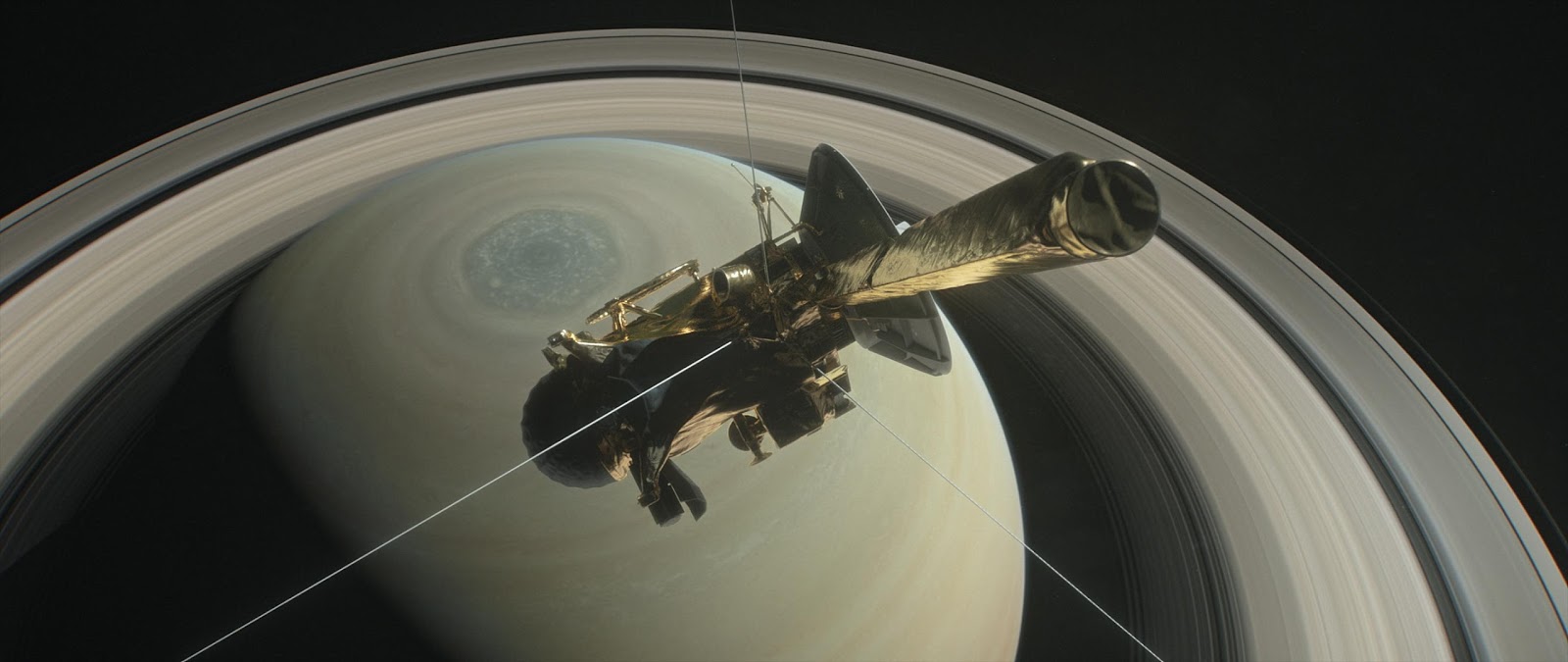
In our image, you can see Saturn and its complex ring system, with a painting of the spacecraft above the planet's north pole, ready to make a dive.
Some of my favorite pictures in the introductory astronomy textbook I am the lead author on come from Cassini (which was the most complicated planetary explorer ever built.) On Friday morning, let's give it a thought as we wake up -- we'll miss you, Cassini!
You can see live coverage of the last days of the mission on NASA TV at: http://nasa.gov/live
You can access the image galleries and latest videos from the mission from this page (designed for the media, but which anyone can use): https://saturn.jpl.nasa.gov/mission/grand-finale/for-media/
By the way, you can access my free textbook at : http://openstax.org/details/astronomy 

Wednesday, January 18, 2017

A New Photo of the Death-Star Moon

Just in time to anticipate the success of the Star Wars film "Rogue One", NASA released a new photo of Mimas, the moon of Saturn's that resembles the "Death Star."
Mimas, an icy world about 250 miles in diameter, has a giant crater on it which is 86 miles across. That's a single impact feature that is one third the diameter of the world that it’s on!!  Astronomers speculate that if the chunk that hit Mimas, exploded, and dug out that crater had been a little bit bigger it might well have shattered that moon.  Then Saturn might have had another ring system around it.
The crater has been named “Herschel” after the astronomer (and musician) who discovered Mimas.  In its center is a mountain that towers almost as high as Mount Everest on Earth.  It’s that central peak that helps our mind’s eye see Mimas’ resemblance to the evil superweapon in the Star Wars series.
The photo was taken in October by the Cassini mission, which has been exploring Saturn, its rings, and its moons since July 2004.  Its spectacular images find their way into every course I teach and every tourist tour of the solar system I guide in my public lectures.

Sunday, October 23, 2016

Water Worlds in the Solar System


There is new evidence for the existence of liquid water in the cold outer regions of our solar system. Astronomers using the Hubble Telescope see plumes of water erupting from the surface of Jupiter’s moon Europa, and measurements of Saturn’s little moon Dione indicate that it must have a substantial layer of liquid water deep underground.
In recent years, more and more evidence has accumulated that liquid water exists among the moons of the giant planets. We have known for a while that there is likely to be an underground ocean of water beneath the icy crust of Jupiter’s moon Europa, and perhaps also under the surface of its moon Ganymede (the largest moon in the solar system.)
Then the Cassini mission found great geysers of salt water emerging from the icy cracks on Saturn’s moon Enceladus, a world much smaller than the Jupiter moons we just discussed. The big deal here is not that there is water, since water ice makes up a large part of many of the solid worlds in the outer solar system. The big discovery is that, even in those icy realms, enough heat can be generated inside these moons to have oceans of liquid water.

The Hubble work is the second report of plumes coming out of cracks in the ice of Europa. Earlier work, also done with the Hubble, also hinted at such plumes, but now astronomers have observed them in ultraviolet light as Europa was crossing the face of Jupiter. Our top image shows you what was observed, with a visible-light picture of Europa photoshopped in to show you what the moon looks like. A short NASA movie explaining the discovery can be seen at:
https://www.youtube.com/watch?v=4QJS9LcB66g
The work on Dione was more indirect. This moon of Saturn’s is about 700 mi across, more than twice as big as Enceladus. The presence of water was suggested by measurement of the gravity of Dione, as the Cassini spacecraft flew by it. The gravity measurements fit with the presence of a water layer deep inside the moon, perhaps 60 mi beneath the surface.
(The bottom image shows a very detailed image of Dione's surface from the Cassini spacecraft.  You see many icy cracks and fractures, whose sides show as white cliffs.)
Something must heat the buried “oceans” in these moons to keep them liquid. In some cases, it is a tug of war between the gravity of the mother planet on one side, and a large moon on the other. Or it may be some kind of rocking back and forth, which scientists call “libration”. Whatever allows liquid water layers to exist out there, the fact that they do makes them an interesting place to look for the beginnings of life.

Water Worlds in the Solar System


There is new evidence for the existence of liquid water in the cold outer regions of our solar system. Astronomers using the Hubble Telescope see a plume of water erupting from the surface of Jupiter’s moon Europa, and measurements of Saturn’s little moon Dione indicate that it must have a substantial layer of liquid water deep underground.
In recent years, more and more evidence has accumulated that liquid water exists among the moons of the giant planets. We have known for a while that there is likely to be an underground ocean of water beneath the icy crust of Jupiter’s moon Europa, and perhaps also under the surface of its moon Ganymede (the largest moon in the solar system.)

Then the Cassini mission found great geysers of salt water emerging from the icy cracks on Saturn’s moon Enceladus, a world much smaller than the Jupiter moons we just discussed. The big deal here is not that there is water, since water ice makes up a large part of many of the solid worlds in the outer solar system. The big discovery is that, even in those icy realms, enough heat can be generated inside these moons to have oceans of liquid water.
The Hubble work is the second report of plumes coming out of cracks in the ice of Europa. Earlier work, also done with the Hubble, also hinted at such plumes, but now astronomers have observed them in ultraviolet light as Europa was crossing the face of Jupiter. Our top image shows you what was observed, with a visible-light picture of Europa photoshopped in to show you what the moon looks like. A short NASA movie explaining the discovery can be seen at:
https://www.youtube.com/watch?v=4QJS9LcB66g
The work on Dione was more indirect. This moon of Saturn’s is about 700 mi across, more than twice as big as Enceladus. The presence of water was suggested by measurement of the gravity of Dione, as the Cassini spacecraft flew by it. The gravity measurements fit with the presence of a water layer deep inside the moon, perhaps 60 mi beneath the surface.
(The bottom image shows a very detailed image of Dione's surface from the Cassini spacecraft.  You see many icy cracks and fractures, whose sides show as white cliffs.)
Something must heat the buried “oceans” in these moons to keep them liquid. In some cases, it is a tug of war between the gravity of the mother planet on one side, and a large moon on the other. Or it may be some kind of rocking back and forth, which scientists call “libration”. Whatever allows liquid water layers to exist out there, the fact that they do makes them an interesting place to look for the beginnings of life.

Sunday, August 10, 2014

An Eclipse of the Sun from Mars


Our Moon is not the only astronomical body that can eclipse the Sun. In August of last year, the cameras aboard the Curiosity rover on Mars caught one of the little moons of Mars, Phobos, making an eclipse.

In the photo, you can see Phobos go across the face of the Sun. Note that the moon's shape is that of a potato (not a sphere).

Phobos is really a small moon (we believe it's an asteroid that Mars captured long ago) -- it is only about 16 miles wide in its longest dimension. The reason it covers so much of the Sun in the picture is that it orbits very close to Mars. It's only 3700 miles above the surface of the red planet.  (Compare that to the 240,000-mile distance of our own Moon!)

If you stood on the surface of Mars, Phobos would be a dim light in the night sky, rising in the west and setting in the east, and taking about 4 hours to go from horizon to horizon. (In other words, Phobos orbits Mars faster than Mars spins or rotates!)


The three black and white images of Phobos crossing the Sun were taken on Aug. 21, 2013 three seconds apart. Not a bad feat of photography by the team running the rover on its mission in Gale crater!


If you want to see Phobos better, below is a remarkable close-up photo of the little moon, taken with the Mars Reconnaissance Orbiter spacecraft, and photo processed to make the color differences more intense:


I was reminded of eclipses because I've just come back from an astronomy meeting where we discussed another August eclipse. In August 2017, our Moon will eclipse the Sun completely. The total eclipse will be visible in only one country -- the United States -- and in a band only 150 miles or so wide. Everyone else in North America will see a "partial eclipse" -- a nice bite taken out of the Sun. We estimate that 500 million people will be able to see the partial eclipse. This could become one of the most dramatic opportunities and challenges for astronomy education in our time. But we'll talk more about that in future blog posts, as the time gets closer.