Showing posts with label Saturn's rings. Show all posts

Wednesday, September 13, 2017

Cassini Space Probe To Fall Into Saturn Friday Morning


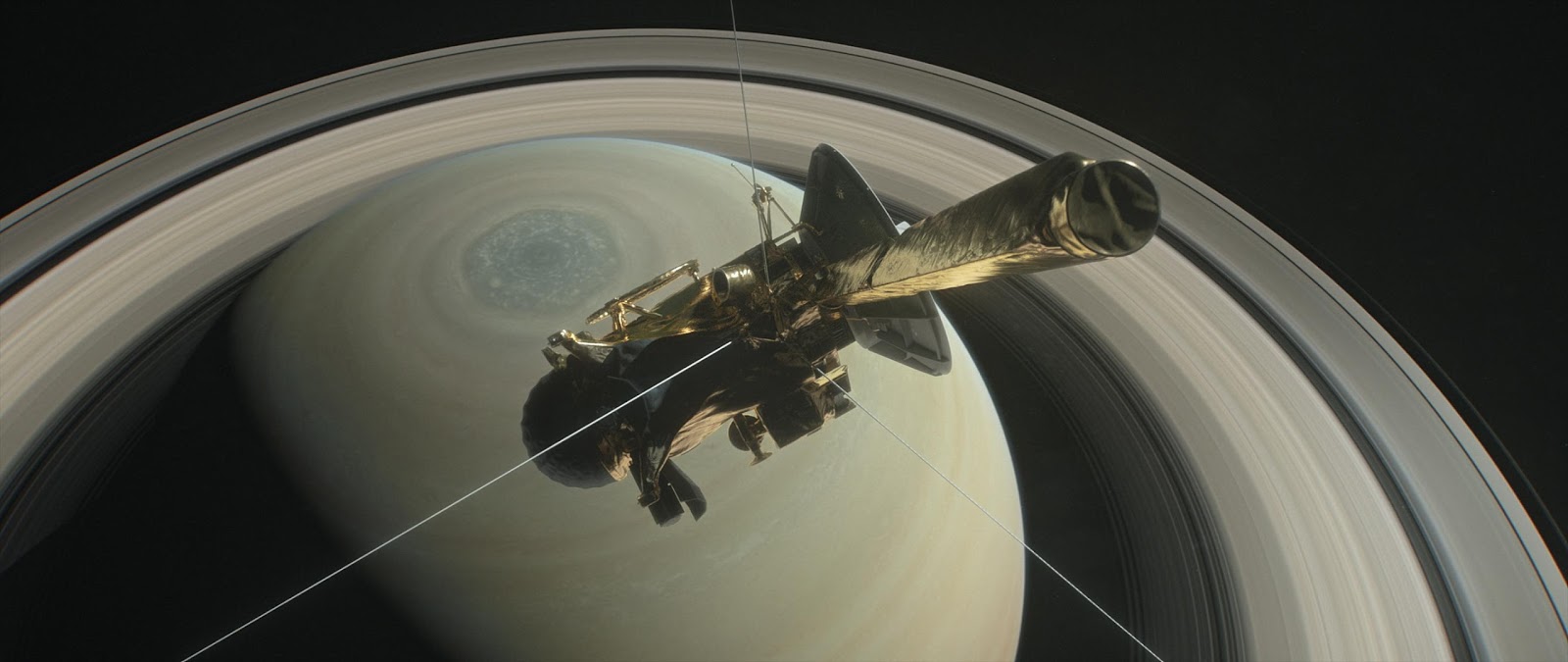
Friday morning, around 5 am Pacific time, NASA will send the Cassini space probe falling into the planet Saturn -- until it is crushed by the pressure in the ringed planet's atmosphere. NASA is commanding Cassini to "commit suicide" before its propellant runs out and it can't be steered any more. Since Saturn has two moons which might harbor some sort of primitive life, we wanted to make sure we did not contaminate those worlds.

The planet Saturn is made mostly of gas and liquid (and its make-up is dominated by the two lightest elements in the universe, hydrogen and helium.) So you can't land ON Saturn, you can only fall INTO Saturn (like a giant ocean world.)
Cassini has been orbiting Saturn for 13 years, sending back amazing pictures and information on the planet, its complicated rings, and its 62 moons. It's made a slew of remarkable discoveries, including the presence of warm salt-water geysers on the relatively small moon called Enceladus, and lakes and rivers of liquid fuel oil on the giant moon Titan. It was launched 20 years ago (so it's had a long and fulfilling life for a spacecraft.)
Since April, it has been swooping in and out of the space between Saturn's cloudtops and its inner rings, an area we had never had the nerve to explore before. NASA estimates the spacecraft has traveled almost 5 billion miles in total and has sent back more than 450,000 picture (that's a Flickr file not even your most picture-taking relatives can compete with!)
In our image, you can see Saturn and its complex ring system, with a painting of the spacecraft above the planet's north pole, ready to make a dive.
Some of my favorite pictures in the introductory astronomy textbook I am the lead author on come from Cassini (which was the most complicated planetary explorer ever built.) On Friday morning, let's give it a thought as we wake up -- we'll miss you, Cassini!
You can see live coverage of the last days of the mission on NASA TV at: http://nasa.gov/live
You can access the image galleries and latest videos from the mission from this page (designed for the media, but which anyone can use): https://saturn.jpl.nasa.gov/mission/grand-finale/for-media/
By the way, you can access my free textbook at : http://openstax.org/details/astronomy 

Sunday, May 14, 2017

A Weird-looking Moon in a Gap in Saturn's Rings


Since 2004, the sophisticated Cassini spacecraft has been orbiting Saturn, sending back remarkable pictures of the planet, its rings, and its moons.   Now, with its fuel running out, the little spacecraft is being directed closer to Saturn’s rings, to get us even better views of this spectacular region (before Cassini does a Kamikaze dive into Saturn Sept. 15th.)

The image above is a fantastic close-up of one of the strangest moons we have ever seen.  The small moon Pan orbits inside the Encke Gap, an emptier region in Saturn’s bright A ring (Saturn’s different rings are given letter names.)  Pan looks like a “flying saucer” – with a set of high ridges around its equator.  It's about 22 miles across at its widest point.

Astronomers think that Pan formed inside Saturn’s ring and, as it grew, its gravity helped clear out the material in the gap which it now rules.  But there was enough material still in the flat ring neighborhood that it fell onto Pan’s equator and made the giant ridges that make Pan so distinctive.

Over the next few months, as scientist program Cassini to dive again and again into the space between Saturn’s and its rings, we will continue to get better images of “things in the rings” (sounds like Dr. Seuss) than we ever have before.  It’s a fitting finale for a spectacular space mission.

The image below shows you the neighborhood.  You can see Pan, its shadow, the Encke gap, and the A ring.  

Sunday, October 16, 2016

Ringshine on the Night Side of Saturn


A spectacular new image of the night side of Saturn and its shining rings in sunlight was released recently by the Cassini mission. You can also see the shadow Saturn casts on its rings.
This August 2016 view shows the complex structure of the planet's rings clearly. You can see the two gaps in the rings, one wider and one narrower (in the outer part of the outer ring.) Close-ups have revealed fainter rings and moons in the gaps, so they are not really as empty as they might seem.
The sunlight reflected from the rings keeps the night side of Saturn from being as dark as it could be, much as moonshine keeps the nights on Earth from being completely dark. One scientist calculated that if you could float in the upper cloud layers of Saturn (which has no solid surface), you could read an astronomy book by ringshine.
Look at the complexity of Saturn's rings -- ringlet after ringlet can be seen in each main ring. And each ringlet consists of millions of icy chunks, all orbiting together around the equator of Saturn. The main composition of these icy chunks is water -- making the rings a significant reservoir of water for future explorers. (Although two of Saturn's moons, Enceladus and Dione, are now thought to have liquid oceans of water under their icy crusts. Perhaps we can siphon some of that instead of melting ring chunks.)
The image was taken from a distance of 870,000 miles (which seems far, but Saturn was about 850 million miles from Earth at that time, so Cassini definitely had the better view.)

Thursday, September 22, 2016

A Great New Image of Saturn


NASA has recently released a spectacular new image of the planet Saturn, seen when it's summer in the Northern Hemisphere. (A year on Saturn is about 30 Earth years, so each season there lasts about 7.5 of our years! Saying goodbye for summer vacation is a big deal there.)
The rings are seen in fine detail with the shadow of the planet toward the left side. The mysterious hexagon-shaped storm at the north pole is also clearly visible. You are seeing Saturn from a distance of about 1.9 million miles.
The image was taken with the Cassini spacecraft that has orbited Saturn and shown us the planet, its rings, and its fantastic moons since 2004.
Enjoy. (Click on the image to see it bigger.)

Wednesday, December 24, 2014

An Amazing Image of Saturn's Rings for the Holidays


Carolyn Porco, the dynamic leader of the Imaging Team for the Cassini Mission (exploring Saturn and its neighborhood), has sent a remarkable holiday greeting card from Saturn and I wanted to share it with you.

What we are looking at is a view of the inner part of Saturn's complicated ring system (mainly the so-called B ring.) We are seeing about 750 miles of the white rim of the B ring, beyond which is the dark emptier space called the Cassini Division. You can see a number of thin "ringlets" in that division toward the upper part of our picture.

But what is really stunning is what the long shadows cast by the Sun reveal at the edge of the bright main ring. You can see peaks or thin mountains of ice particles, sticking up more than a mile and a half (2 km) above the plane of the rings. Compare those heights with the typical height of the ring system, which is about 10 meters (or about 30 feet) in most places.

Here is what Carolyn says about the image, "Cassini scientists believe that this is one prominent region at the outer edge of the B ring where large bodies, or moonlets, up to a kilometer or more in size, are found. It is possible that these bodies significantly affect the ring material streaming past them, and force the particles upward, in a "splashing" manner."

She continues, "This image [taken in 2009] and others like it are only possible around the time of Saturn's equinox, which occurs every half-Saturn-year, or about every 15 Earth years. The illumination geometry that accompanies equinox lowers the sun's angle to the ring plane and causes structures jutting out of the plane to cast long shadows across the rings."

The rings of Saturn are made of billions and billions (as Carl Sagan used to say) of individual chunks of ice -- mostly water ice. The particles range in size from smaller than a sand grain to larger than a modern SUV. We have known for some time that the interaction of moons and rings in the Saturn system can create a wide range of artistic patterns using the ring particles as their raw materials. But these tall icicles or icy towers are among the most spectacular we have ever seen.

Happy Holidays. May 2015 bring all of us more amazing views of our cosmic environment and increase our understanding that the differences that separate us on Earth are so trivial compared to the truly alien nature of what's out there.


[Click on the image to make it bigger and see even more detail!]


Monday, January 27, 2014

Gorgeous Picture of Saturn from Above


Today, I just want to share a beautiful image with you. This view of planet Saturn, seen from above by the Cassini spacecraft was assembled from a variety of close-up images by computer programmer and amateur image processor Gordan Ugarkovic, but released by NASA because they were so pleased with the result.

Here we are looking down on the North Pole of Saturn in October 2013 (the weird weather feature called the "Hexagon" is faintly visible around the pole.) Such a perspective is not possible from Earth, but only from a spacecraft like Cassini.

The Sun is off to the left in this picture, and we see the planet casting a dark shadow on its own rings.  The bands of "stormy weather" at different latitudes are also visible. Saturn is a planet made mainly of gas and liquid. If you were to try to "land" on Saturn, you wouldn't -- you'd just sink in and in.

You can see Saturn's main ring system surrounding the planet's equator. To give you a sense of scale, if we were to put Saturn down next to the Earth, the ring system would stretch almost from the Earth to the Moon. Click on the photo to see it bigger and enjoy!

You can see more of Gordan's home processed Saturn photos at:http://www.flickr.com/photos/ugordan/sets/72157594305165539/

Sunday, December 23, 2012

A Fabulous New Saturn Image


This magnificent (but artificial color) image of the ringed planet Saturn was assembled and enhanced from 60 different pictures taken with the Cassini spacecraft. You are looking up at Saturn from a perspective below its rings, at a time when the Sun happened to be directly behind Saturn. Thus we are seeing the planets and the rings back-lit, something we can never see from Earth.

The image is constructed not merely with visible light pictures, but also with some in the infra-red (commonly called heat rays). So this is not what your eyes would see if you (like Cassini) were orbiting Saturn -- this is a view only our sophisticated instruments can make available. And the details have been enhanced to show you the complex structure of Saturn's rings (made up of billions of chunks of mostly water ice, all moving around the equator of Saturn in a traffic pattern so vast it puts the Los Angeles freeway system to shame.) 


From one side to the other, Saturn's giant ring system spans 170,000 miles across.   This means that if you were to take the ring system off Saturn and put it next to the Earth, it would almost fill the space between the Earth and the Moon.

Near the top of the picture, you see the round dark shadow that Saturn casts on its own rings. Below that shadow, the greenish glow is light reflected from the rings on to the cloudtops of Saturn.

The pictures that make up this fantastic mosaic were taken from a distance of about 500,000 miles from Saturn (quite close in astronomical terms.)  Just look at all the structure you can see in the ring system, which consists of many, many ringlets.

What a beautiful holiday ornament this planet makes!  Happy Holidays.