Showing posts with label Titan. Show all posts

Wednesday, September 13, 2017

Cassini Space Probe To Fall Into Saturn Friday Morning


Friday morning, around 5 am Pacific time, NASA will send the Cassini space probe falling into the planet Saturn -- until it is crushed by the pressure in the ringed planet's atmosphere. NASA is commanding Cassini to "commit suicide" before its propellant runs out and it can't be steered any more. Since Saturn has two moons which might harbor some sort of primitive life, we wanted to make sure we did not contaminate those worlds.

The planet Saturn is made mostly of gas and liquid (and its make-up is dominated by the two lightest elements in the universe, hydrogen and helium.) So you can't land ON Saturn, you can only fall INTO Saturn (like a giant ocean world.)
Cassini has been orbiting Saturn for 13 years, sending back amazing pictures and information on the planet, its complicated rings, and its 62 moons. It's made a slew of remarkable discoveries, including the presence of warm salt-water geysers on the relatively small moon called Enceladus, and lakes and rivers of liquid fuel oil on the giant moon Titan. It was launched 20 years ago (so it's had a long and fulfilling life for a spacecraft.)
Since April, it has been swooping in and out of the space between Saturn's cloudtops and its inner rings, an area we had never had the nerve to explore before. NASA estimates the spacecraft has traveled almost 5 billion miles in total and has sent back more than 450,000 picture (that's a Flickr file not even your most picture-taking relatives can compete with!)
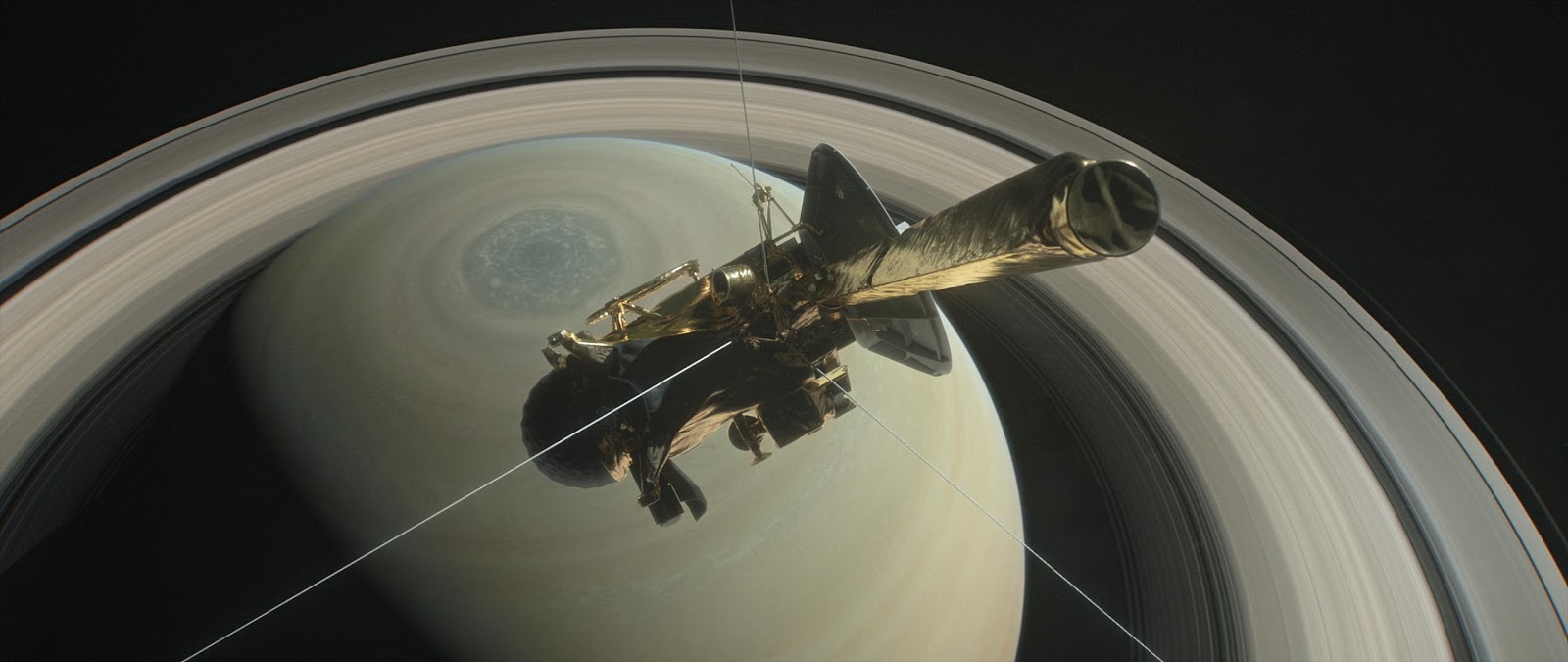
In our image, you can see Saturn and its complex ring system, with a painting of the spacecraft above the planet's north pole, ready to make a dive.
Some of my favorite pictures in the introductory astronomy textbook I am the lead author on come from Cassini (which was the most complicated planetary explorer ever built.) On Friday morning, let's give it a thought as we wake up -- we'll miss you, Cassini!
You can see live coverage of the last days of the mission on NASA TV at: http://nasa.gov/live
You can access the image galleries and latest videos from the mission from this page (designed for the media, but which anyone can use): https://saturn.jpl.nasa.gov/mission/grand-finale/for-media/
By the way, you can access my free textbook at : http://openstax.org/details/astronomy 

Sunday, August 17, 2014

Clouds Moving Across a Lake on Saturn's Moon Titan


Recently released images from the Cassini probe in the Saturn system show fresh clouds moving slowly above a giant lake on Saturn's moon Titan.  The lake itself is not water, but probably liquid methane and ethane (methane is what we call natural gas on Earth and ethane is an ingredient in fuel).

Now you might say, big deal, so there are clouds on top of a lake. I can see that anytime on Earth.  But the big difference is that the temperature on this distant moon is so cold, that water there is always frozen harder than rock.  So lakes, rivers, rain drops, and clouds can only form from substances that can stay liquid and gas at very cold temperatures.  Methane plays the same role on Titan that water plays on Earth -- it can be solid ice, flowing liquid, and gas in the atmosphere.  The clouds we see are condensations of droplets of methane. (As always, click on the picture to see it bigger.)

Even just having the images is a real tribute to our technology.  When we first got close-up images of Titan from space missions that flew by, its surface was not visible.  The entire giant moon is covered with a thick haze.  Light cannot make it through such haze (as people in Los Angeles on bad air days know all too well :-)), so we equipped the Cassini spacecraft with special instruments that can "see" infrared (heat rays) and radar -- waves that do get through the thick atmosphere of Titan.

The lake above which we see the new clouds is called Ligeia Mare (the Ligeian Sea), the second largest known body of liquid outside the Earth.  It's so big that if you walked around it, you'd walk 1240 miles.  Winds on Titan are pushing the clouds over the lake at speeds of about 7 to 10 miles per hour.

A large storm in 2010 cleared the atmosphere of Titan of most clouds, and astronomers who follow the weather on this distant moon have been waiting for the summer cloud patterns in Titan's northern hemisphere to return.

NASA's imaging wizards even put together a little movie of the cloud motions, which you can see at: http://photojournal.jpl.nasa.gov/archive/PIA18420.gif

The movie is not going to win any Oscars, but as you watch the few frames with different amounts of detail showing, remind yourself that you are watching images taken 900 million miles from Earth by a fragile spacecraft that has been orbiting through the Saturn system for almost 10 years.

By the way, if you want to see the shape of Lake Ligeia, see the image below, taken with radar, that shows it especially well:

Wednesday, September 11, 2013

An Alien Sea on a Moon of Saturn's


I want to introduce you today to Ligeia Mare (the Ligeian Sea), the second largest known body of liquid outside the Earth. It's on the surface of Saturn's moon Titan, the only moon in the solar system to have a thick atmosphere and, therefore, to have air pressure. It's air pressure that keeps liquids from evaporating and makes rivers, lakes, and seas possible.

And to our delight, Titan, despite the freezing cold temperatures in the Saturn System, has rivers, lakes, and seas. At Titan temperatures, water is frozen until it's harder than rock on Earth. So the bodies of liquid on Titan are not water, but methane and ethane, which can be liquid under Titan conditions. Methane is natural gas (and also what comes out of both ends of the cow after it has been digesting its food for a while.) Ethane is a chemical that is often found in natural gas and is also a product of refining oil.

Take a look at the picture. This is not a photograph, but an image that comes from bouncing radar beams off Titan, something we equipped our clever little Cassini spacecraft to do. On radar pictures, rough things show up light, smooth things (like bodies of liquid) show up dark. The colors are added artificially to make the picture more interesting.

The name Ligeia comes from one of the sirens of Greek mythology, beautiful creatures who lured sailors toward rocky shores and their certain death. Look at Ligeia on the image -- ain't she beautiful? Some people see the shape of a sleeping dog, with its head toward the bottom. But its size is what astounds. The sea is about the size of the Earth's Caspian sea and if you walked completely around it on the shore, you'd walk a total of 1,240 miles.

Where the radar picture is black, the sea is deep; where you see grey, the sea is more shallow, so the radar beam can hit the sea bottom and some of it bounces back. Already scientists have proposed a mission (not approved yet) to splash down a capsule in Ligeia Mare and either drift or purposely navigate around the sea, sending back images to Earth.

It's been winter in the North polar region of Titan since Cassini arrived in the neighborhood. Some scientists think that once the weather starts to warm up on Titan (it will still be outrageously cold compared to Earth,) the Titan winds might blow hard enough to make waves on this alien sea, and our radar might just pick up those waves. (Somebody should tell the Beach Boys that surf might soon be up another world!)


For more details about weather on Titan, see:
http://www.nasa.gov/mission_pages/cassini/whycassini/cassini20130522.html#.UjEPocYqh8E

Wednesday, January 9, 2013

More Planets Out There and Too Much Astronomy News


This week, 2800 astronomers are gathered in Southern California for the winter meeting of the American Astronomical Society and the news from the meeting is coming so fast and furious even seasoned astronomy fans are somewhat overwhelmed. Let me just list a few of the news stories for you for now and we will explore some of them further in future posts.

The picture I have attached above shows new information about the planet orbiting the star Fomalhaut, the 17th brightest star in the night sky (and, at a distance of only 25 light years, one of the closer stars to us.) The faint distant planet, one of the first planets outside the solar system to be actually photographed, is shown here in an image from the Hubble Space Telescope.

In the image, the bright star has been covered up by a dark disk (in the middle) that the Hubble telescope can use to block light. That allows us to see the planet and the huge dusty disk surrounding the star. The planet has an orbit that takes it around its star in about 2000 Earth years. (Compare that to a 1-year orbit for Earth and a 12-year orbit for Jupiter.) So some astronomical commentators are suggesting it might be more of a giant comet or a distant ice-dwarf (like Pluto) and not really the kind of planet we first think of when we talk about planets.

In a related story, the Kepler mission team, searching for planets that "eclipse" their stars (see earlier posts of mine on this mission), is reporting 461 new planet candidates, bringing their total number of possible planets to 2,740! Four of the new candidates are less than twice the size of Earth and orbiting where conditions are Earth-like.

Nest, teams of astronomers using orbiting telescopes have filed the most detailed "weather report" yet about clouds in the atmosphere of a "brown dwarf" -- the name we give to a failed star. These objects begin life like stars do, but can't keep making energy in the way our Sun and others stars can. It's amazing that we can now probe for the existence of Earth-sized clouds in the outer layers of these remote, faint objects.

Plus there is the possible discovery of floating icebergs on Saturn's moon Titan, an asteroid belt around the bright star Vega, and much more. (The reason there is so much news all at once is that astronomers save their discoveries for announcement at this annual winter meeting, so they can share the results with their colleagues and argue about them right then and there. With almost 3000 astronomers gathered in the same convention center, there is a good clump of experts to dissect and admire each discovery.)

More details in posts to come.

Wednesday, January 2, 2013

River Found on Saturn's Large Moon Titan


Scientists working with the Cassini space probe orbiting Saturn have recently identified a river more than 200 miles long on the moon Titan. You can see the river valley running into a large sea (to the right) on the radar image. Like the seas on this frigid moon, the river is not filled with liquid water (much too cold for that), but probably liquid methane (swamp gas) and ethane.

Titan has a thick, smoggy atmosphere, so the spacecraft can't just look for features like this using ordinary light. Instead, one of its instruments does the same thing that airport controllers do to keep track of aircraft. It bounces radar beams off the moon's surface and then makes an image using the radar information. On such radar pictures, dark means smooth, light means rough. You can see the smooth dark surface of the river on the accompanying picture, which makes scientists think that the river basin really is full of a flowing liquid with a smooth surface.


This is the first flowing river found on another world besides Earth. Mars has dried-up river beds, but its atmosphere is much too thin to allow liquid rivers or seas today. Titan, on the other hand, has an atmosphere thicker than Earth's, so the pressure is enough to allow liquids to flow.

Earlier radar (and infrared) images of Saturn have identified a number of lakes on Titan, including one as large as Lake Ontario.  There are also images that over time, show liquid areas getting smaller and larger, as if they evaporated and then were filled again -- perhaps by rainfall.  (Once again, this would be a rain of cold ethane and methane, not water.)  Just like the Earth is at "the triple point" of water (boasting temperatures and pressures where water can be solid, liquid and gas), so Titan appears to be at the triple point of methane and ethane and so we can have these substances as vapor, bodies of liquid, and icebergs.

I'm just about to teach my introductory astronomy class on the planets at Foothill College starting Monday and Tuesday, and between the new pictures from Mars and Saturn (to say nothing of Mercury), we'll have lots of astronomy news to keep us occupied. If you can't attend, don't worry. I'll also continue to share the news on this blog as we go along.

Wednesday, July 4, 2012

Saturn's Large Moon May Have Underground Ocean


Measurements from the Cassini spacecraft orbiting Saturn, made between 2006 and 2011, indicate that Saturn's largest moon may have a layer of liquid water under its icy surface. 

This intriguing moon, called Titan, is already notorious for having an atmosphere thicker than Earth's -- something no other known moon has. Under Titan's atmosphere, Cassini has shown us lakes and rivers made of methane (liquid swamp gas) and not water. The temperature in that cold region of the solar system is always low and Titan's frigid surface is at something like - 290 degrees Fahrenheit.

At such temperatures, water on the surface is frozen solid -- in fact, "rocks" on Titan (photographed by our little lander) are made of water ice. But the new measurements indicate that below its outer icy shell, Titan may contain an ocean of liquid water. 
 At such temperatures, water on the surface is frozen solid -- in fact, "rocks" on Titan (photographed by our little lander) are made of water ice. But the new measurements indicate that below its outer icy shell, Titan may contain an ocean of liquid water.

This is not the only moon in the solar system where astronomers suspect that liquid water may exist underground -- several of Jupiter's moons, especially the one called Europa -- also show indications of a sub-surface ocean. 

And, a much smaller moon of Saturn's, called Enceladus, has steamy geysers of salt water erupting from giant cracks. Water seems to be a common substance in the solar system (and the universe) and we are detecting it as vapor, as solid ice, and -- increasingly -- in liquid forms under the surface of other worlds.