Showing posts with label Enceladus. Show all posts

Wednesday, September 13, 2017

Cassini Space Probe To Fall Into Saturn Friday Morning


Friday morning, around 5 am Pacific time, NASA will send the Cassini space probe falling into the planet Saturn -- until it is crushed by the pressure in the ringed planet's atmosphere. NASA is commanding Cassini to "commit suicide" before its propellant runs out and it can't be steered any more. Since Saturn has two moons which might harbor some sort of primitive life, we wanted to make sure we did not contaminate those worlds.

The planet Saturn is made mostly of gas and liquid (and its make-up is dominated by the two lightest elements in the universe, hydrogen and helium.) So you can't land ON Saturn, you can only fall INTO Saturn (like a giant ocean world.)
Cassini has been orbiting Saturn for 13 years, sending back amazing pictures and information on the planet, its complicated rings, and its 62 moons. It's made a slew of remarkable discoveries, including the presence of warm salt-water geysers on the relatively small moon called Enceladus, and lakes and rivers of liquid fuel oil on the giant moon Titan. It was launched 20 years ago (so it's had a long and fulfilling life for a spacecraft.)
Since April, it has been swooping in and out of the space between Saturn's cloudtops and its inner rings, an area we had never had the nerve to explore before. NASA estimates the spacecraft has traveled almost 5 billion miles in total and has sent back more than 450,000 picture (that's a Flickr file not even your most picture-taking relatives can compete with!)
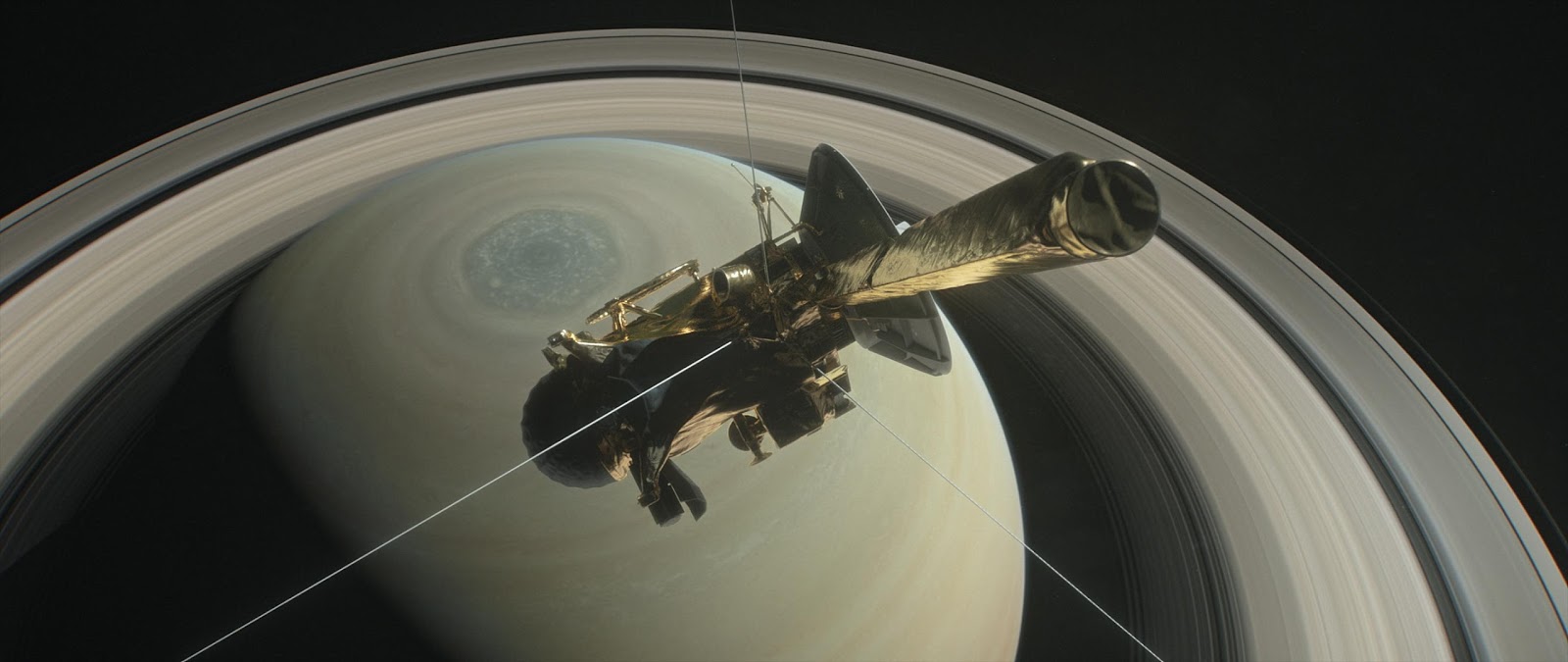
In our image, you can see Saturn and its complex ring system, with a painting of the spacecraft above the planet's north pole, ready to make a dive.
Some of my favorite pictures in the introductory astronomy textbook I am the lead author on come from Cassini (which was the most complicated planetary explorer ever built.) On Friday morning, let's give it a thought as we wake up -- we'll miss you, Cassini!
You can see live coverage of the last days of the mission on NASA TV at: http://nasa.gov/live
You can access the image galleries and latest videos from the mission from this page (designed for the media, but which anyone can use): https://saturn.jpl.nasa.gov/mission/grand-finale/for-media/
By the way, you can access my free textbook at : http://openstax.org/details/astronomy 

Sunday, October 23, 2016

Water Worlds in the Solar System


There is new evidence for the existence of liquid water in the cold outer regions of our solar system. Astronomers using the Hubble Telescope see plumes of water erupting from the surface of Jupiter’s moon Europa, and measurements of Saturn’s little moon Dione indicate that it must have a substantial layer of liquid water deep underground.
In recent years, more and more evidence has accumulated that liquid water exists among the moons of the giant planets. We have known for a while that there is likely to be an underground ocean of water beneath the icy crust of Jupiter’s moon Europa, and perhaps also under the surface of its moon Ganymede (the largest moon in the solar system.)
Then the Cassini mission found great geysers of salt water emerging from the icy cracks on Saturn’s moon Enceladus, a world much smaller than the Jupiter moons we just discussed. The big deal here is not that there is water, since water ice makes up a large part of many of the solid worlds in the outer solar system. The big discovery is that, even in those icy realms, enough heat can be generated inside these moons to have oceans of liquid water.

The Hubble work is the second report of plumes coming out of cracks in the ice of Europa. Earlier work, also done with the Hubble, also hinted at such plumes, but now astronomers have observed them in ultraviolet light as Europa was crossing the face of Jupiter. Our top image shows you what was observed, with a visible-light picture of Europa photoshopped in to show you what the moon looks like. A short NASA movie explaining the discovery can be seen at:
https://www.youtube.com/watch?v=4QJS9LcB66g
The work on Dione was more indirect. This moon of Saturn’s is about 700 mi across, more than twice as big as Enceladus. The presence of water was suggested by measurement of the gravity of Dione, as the Cassini spacecraft flew by it. The gravity measurements fit with the presence of a water layer deep inside the moon, perhaps 60 mi beneath the surface.
(The bottom image shows a very detailed image of Dione's surface from the Cassini spacecraft.  You see many icy cracks and fractures, whose sides show as white cliffs.)
Something must heat the buried “oceans” in these moons to keep them liquid. In some cases, it is a tug of war between the gravity of the mother planet on one side, and a large moon on the other. Or it may be some kind of rocking back and forth, which scientists call “libration”. Whatever allows liquid water layers to exist out there, the fact that they do makes them an interesting place to look for the beginnings of life.

Water Worlds in the Solar System


There is new evidence for the existence of liquid water in the cold outer regions of our solar system. Astronomers using the Hubble Telescope see a plume of water erupting from the surface of Jupiter’s moon Europa, and measurements of Saturn’s little moon Dione indicate that it must have a substantial layer of liquid water deep underground.
In recent years, more and more evidence has accumulated that liquid water exists among the moons of the giant planets. We have known for a while that there is likely to be an underground ocean of water beneath the icy crust of Jupiter’s moon Europa, and perhaps also under the surface of its moon Ganymede (the largest moon in the solar system.)

Then the Cassini mission found great geysers of salt water emerging from the icy cracks on Saturn’s moon Enceladus, a world much smaller than the Jupiter moons we just discussed. The big deal here is not that there is water, since water ice makes up a large part of many of the solid worlds in the outer solar system. The big discovery is that, even in those icy realms, enough heat can be generated inside these moons to have oceans of liquid water.
The Hubble work is the second report of plumes coming out of cracks in the ice of Europa. Earlier work, also done with the Hubble, also hinted at such plumes, but now astronomers have observed them in ultraviolet light as Europa was crossing the face of Jupiter. Our top image shows you what was observed, with a visible-light picture of Europa photoshopped in to show you what the moon looks like. A short NASA movie explaining the discovery can be seen at:
https://www.youtube.com/watch?v=4QJS9LcB66g
The work on Dione was more indirect. This moon of Saturn’s is about 700 mi across, more than twice as big as Enceladus. The presence of water was suggested by measurement of the gravity of Dione, as the Cassini spacecraft flew by it. The gravity measurements fit with the presence of a water layer deep inside the moon, perhaps 60 mi beneath the surface.
(The bottom image shows a very detailed image of Dione's surface from the Cassini spacecraft.  You see many icy cracks and fractures, whose sides show as white cliffs.)
Something must heat the buried “oceans” in these moons to keep them liquid. In some cases, it is a tug of war between the gravity of the mother planet on one side, and a large moon on the other. Or it may be some kind of rocking back and forth, which scientists call “libration”. Whatever allows liquid water layers to exist out there, the fact that they do makes them an interesting place to look for the beginnings of life.

Sunday, June 7, 2015

Where Would Bill Gates' Great Granddaughter Go for Her Honeymoon?


Imagine a future when space travel is common-place and you can visit the planets.  What will be the top tourist sights in our solar system?  (This is an activity I like to have my students think about as they get near the end of my introduction to the planets class.)

If you are an astronomy fan, play the game yourself. What would you pick for those once-in-a-lifetime sights that future travelers may want to visit and photograph on a honeymoon trip or graduation journey?  

For those of you who happen to be in Northern California on Saturday evening, June 20th, I will be revealing my favorites in a free public talk on Mt. Tamalpais just north of San Francisco.  (My first-ever outdoor lecture with slides!)

For those elsewhere, I'll give you a sample.  Some of my favorite stops include the 4,000-mile lava channel on Venus (always a good planet for a hot time), the towering Mount Olympus volcano on Mars (three times the height of Mount Everest), the awesome Verona Cliffs on the moon Miranda (which are the tallest “lover’s leap” in the solar system), and the recently discovered steam geysers on Saturn’s intriguing moon Enceladus (nicknamed “Cold Faithful.”)

After the lecture, there will be a laser-guided tour of the night sky by Paul Salazar and stargazing through the telescopes of the San Francisco Amateur Astronomers. This is an OUTDOOR venue, so we ask that people dress appropriately (it can get cold), and bring a flashlight to help find your way to and from the parking lots.


Admission is free, but seating is on a first-come, first-served basis. 

If it looks like rain, please call the Mt. Tam hotline at 415-455-5370, after 4 pm.  Since this is an outdoor event, it gets canceled if it is raining.

Our photo shows Saturn casting a shadow on its own sunlit rings in a view from the Cassini spacecraft.